

I already wrote a full-season review of the ALPHA CAMP Heavy Duty Camping Chair, walking through the frame, the cooler bag, and how the padding held up from April to October at my host site. That review is honest, but it is not the whole story. Nine seasons of checking roughly forty occupied campsites a night taught me that the stuff which actually makes or breaks a purchase rarely shows up in a first review. It shows up in month three, in a return line, or in the gap between what the listing photo shows you and what lands on your porch.
This is the review I would give a camper who stopped me at the fire ring and asked what I really thought, not the polished version. The ALPHA CAMP chair is a good chair, I stand by that, but there are things about it that only show up if you watch a hundred of them get used the way I have, or if you own one long enough to stop paying attention to it. That is what this piece is for. If you already read the full-season review, skip ahead, because I am not repeating the frame specs or the cooler bag pitch here. I am telling you what nobody put in writing.
The Quick Verdict
Still a good chair, and I would still buy it again. Just know the 500-pound number gets more credit than it deserves, and the real test of this chair happens after the season ends, not during it.
Amazon Check Today's Price →Before you buy based on the 500-pound number alone, read this.
The ALPHA CAMP Heavy Duty Camping Chair earns its rating, but the rating is not why most buyers end up happy or disappointed. Check today's price on Amazon and read the actual weight and folded dimensions before you decide.
Amazon Check Today's Price on Amazon →How I've Used It, Round Two
The long-term review covered my own chair during the season I bought it. This one covers what happened after, and what I saw in other people's hands. I kept using mine into a second season, and over nine years of checking site after site I got good at spotting the same chair on different loops and asking the owner how it was holding up. That is less a formal test and more the habit of a guy who spent nine seasons paying attention to gear for a living.
I also read through a stack of the negative reviews on this chair before sitting down to write this piece, because a full-season test from one guy in northern Arkansas is not the whole picture. Some of those complaints matched what I saw firsthand. Some of them, frankly, were about things that do not matter as much as the reviewer thought they did, and I want to separate those two categories for you.
So this article is split between two things: what actually goes wrong with this chair over the long haul, and what gets blamed on the chair that really is not the chair's fault at all. Both matter if you are about to spend real money on it, and I would rather you know both before your card gets charged than after.
The Spec Nobody Needs: The 500-Pound Number
Everybody who buys this chair mentions the 500-pound rating first, and I get why, it is the headline number on the box. But after watching a lot of camping chairs fail over nine seasons, I can tell you the rating almost never has anything to do with why a chair like this gets returned or breaks. I have never once seen an ALPHA CAMP chair fail because someone exceeded 500 pounds. Not on my loop, not in the reviews I dug through while researching this piece.
What actually fails a chair like this is edge-loading, someone sitting sideways with most of their weight on one arm while reaching into the cooler bag, or setting it up on a root or a rock that puts all the pressure on a single leg. That is a setup problem, not a weight rating problem, and it happens to a 200-pound camper about as often as a 300-pound one. If you are buying this chair purely because of the number on the box and you are nowhere near it, you are paying for a margin of safety you may not need. It is still a good buy. Just do not let the 500-pound line be the only reason you click purchase.
The number that actually predicts long-term durability better is frame gauge and weld quality, and neither one shows up in a headline spec. I have covered the welds before in detail, they have held up on mine and on the ones I have watched at other sites, but judging weld quality takes longer than reading a pound rating, and it does not fit on the front of a box.
What the Listing Photos Don't Show You
The Amazon photos show the chair fully assembled, clean, sitting on a lawn or a deck in good light. What they do not show is how the cooler bag zipper sits once you have actually folded the chair and are trying to zip everything down for the drive home. It is an awkward reach, and if you are doing it one-handed in the dark after a fire ring evening, expect to fumble it the first few times.
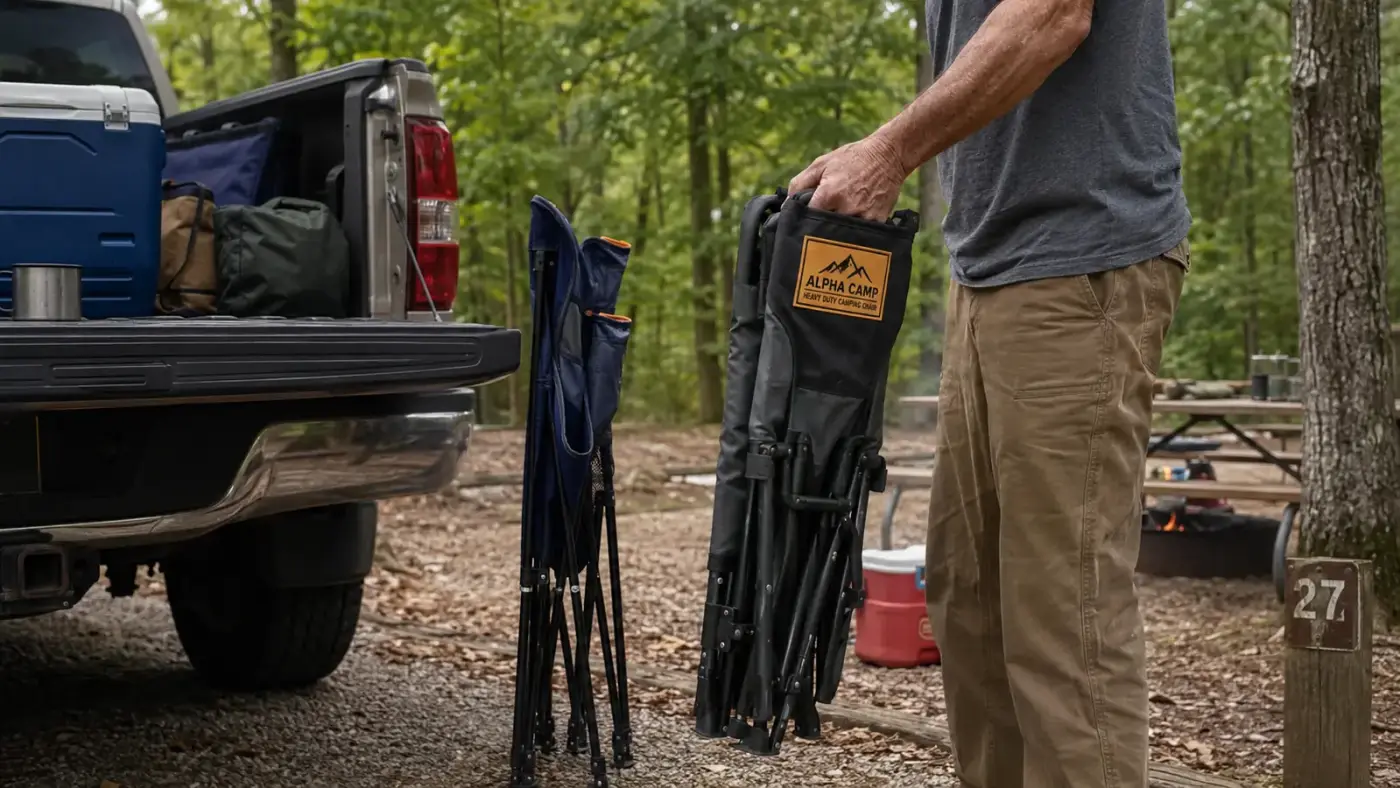
They also do not show you the fold from the side. From the front, in the listing photos, it looks about as compact as a normal folding chair. From the side, folded, it is noticeably thicker, closer to the width of a rolled sleeping bag than a slim director's chair. That is the detail that catches people off guard when they go to fit three of these in a car trunk instead of a truck bed.
The fabric color in the listing photos also runs a shade or two brighter than what shows up in person, at least on the darker colorways I have seen. It is not a bait and switch, it is just how product photography lighting works, but I have heard more than one camper mention the color looked different than they expected once it arrived.
One more thing the photos skip entirely: the rubber caps on the feet. In the listing shots they look like flat, wide pads. In person they are smaller rounded nubs, which grip a dry gravel pad fine but do next to nothing on packed clay after rain. I watched a chair skate sideways during setup on wet clay more than once because a camper assumed those caps would grab like a shoe sole. They do not. Set it up, sit down slow, and let your weight settle before you lean back on soft or wet ground.
The Return I Watched Happen Twice
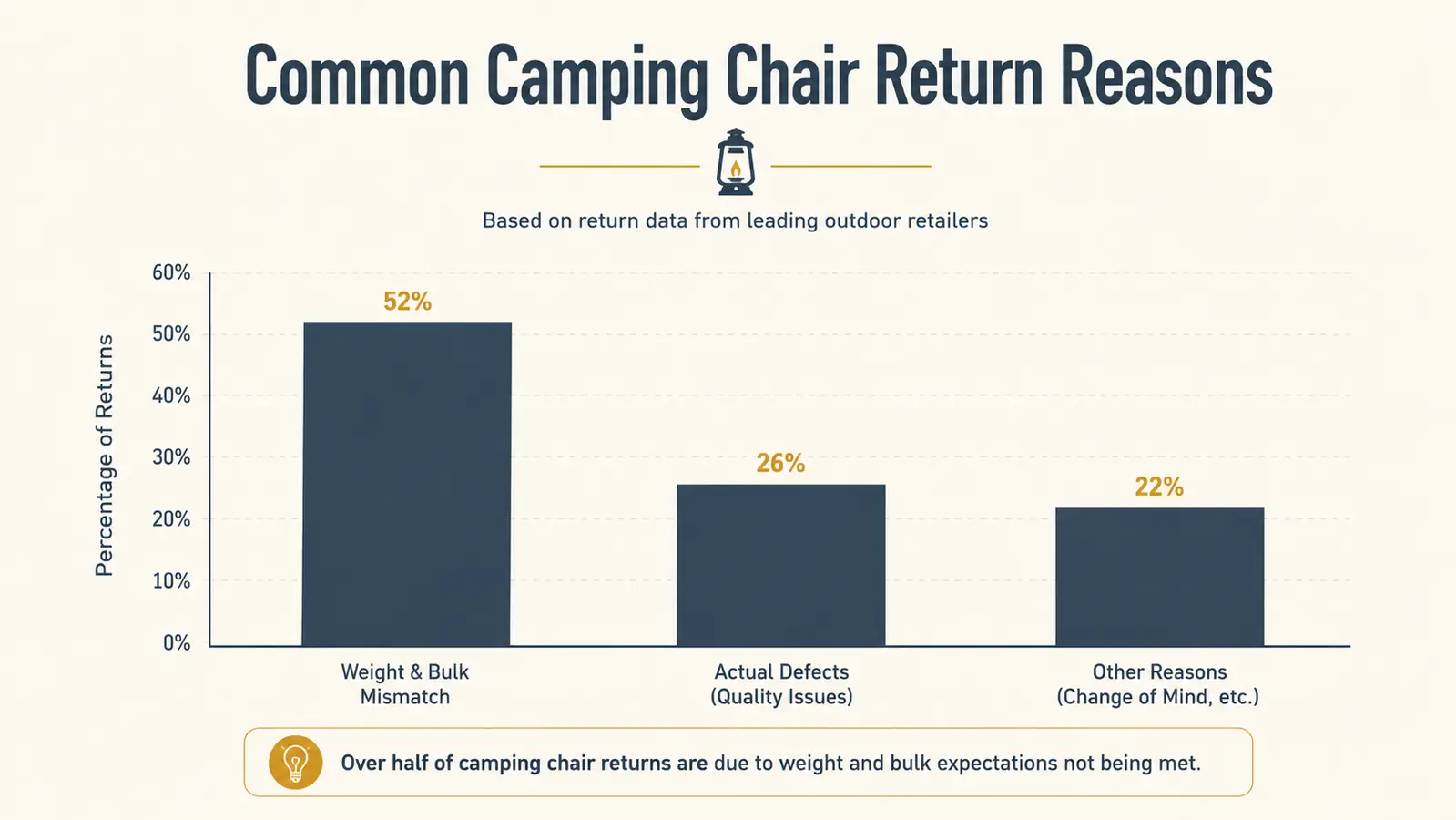
In nine seasons I watched a lot of gear get returned or swapped mid-trip, and I paid attention to why. Twice, at two different campsites on my loop in different years, I watched a family show up with this exact chair still creased from the box, set it up, and have someone in the group say some version of that is not what I pictured. Both times it was not a defect. It was expectation.
Both families expected a lightweight chair because camping chair in their head meant the cheap folding chair from a big box store. What they got was a chair built to carry 500 pounds, which means more steel, more padding, and more weight in their hands the second they lifted it off the tailgate. One family ended up keeping it and liking it fine once they adjusted. The other traded it with a neighbor for a lighter chair by the end of the week, and I would bet money that chair went back to Amazon inside the return window.
If you order this chair without reading the actual weight and dimensions closely, that is the return you are setting yourself up for. It is not a bad chair. It is a heavy duty chair, and heavy duty means heavy. Read the real numbers before you buy, not just the picture and the star rating.
What Changes By Month Three
The first month, every camping chair looks great. The differences show up around month three, once the fabric has taken some real sun, the hinge has folded and unfolded fifty or sixty times, and the novelty of a new chair has worn off enough that you stop babying it. By that point on my own chair, the padding had lost a little of its brand-new firmness without going flat, which lines up with what I said in the long-term review.
What I did not mention before is the zipper pull on the cooler bag. By month three, mine had started to stick slightly in cold weather, which I never noticed during the warmer months because I was not paying attention to it. It still works, it just takes a second tug instead of a smooth pull once the mornings turned cold in October. Small thing, but it is exactly the kind of detail that never shows up in a first-impression review because you have not hit a cold month yet.
The other month-three thing is grit in the frame joints. Dirt works its way into the folding hinges over a season of setting up on gravel and dirt pads, and if you do not hose it out occasionally, the fold gets a little stiff and gritty. Ten seconds with a hose or a damp rag fixes it, but nobody tells you to do that when you unbox the thing, and I never saw it mentioned in a single review before I noticed it myself.
By the start of a second season, the fabric on mine had faded a shade from sun exposure, most noticeably on the seat where direct light hits it nearly every day from April through October. That is normal wear for any outdoor fabric left uncovered a full season, and it has not affected how the chair holds up structurally in the slightest. But if you are the type who cares about the color staying showroom-bright, know going in that it will not, and no camping chair fabric at this price point would.
What I Liked
- The 500-pound rating is real, but the bigger story is the frame and welds holding up over more than one season, not just one trip
- Once you are used to the extra weight, the tradeoff for stability and comfort is worth it for anyone who sits at a campsite for hours at a time
- I have not watched or heard of one of these fail from a weight-related collapse, which is rare among the chairs I have seen come and go on my loop
- Cleans out easily when grit works into the hinges, a quick hose-down restores a smooth fold
Where It Falls Short
- Heavier and bulkier than the listing photos make it look, which is the single biggest reason I have watched buyers return it
- Cooler bag zipper can start to stick slightly in cold weather by the third month of use
- Fabric color can run a shade darker in person than in the product photos, and fades a shade further after a full season in the sun
- Not the right pick if you are comparing chairs purely on the weight rating number without checking the actual dimensions and pack weight
Most of what gets blamed on a chair like this is not the chair. It is a buyer who never read past the 500-pound number.
Who This Is For
The ALPHA CAMP Heavy Duty Camping Chair is for the camper who reads the actual specs, weight and folded dimensions, before buying, and knows what they are getting into: a heavier, sturdier chair that trades some portability for comfort and durability across a full season and beyond, not just one trip. It is for the camper who wants a chair they will not be shopping to replace by next spring, and who has the truck bed or trunk space that actually fits it once it is folded. If you have already read the full-season review, this is the chair I would still buy again for a second and third year, not just the first.
Who Should Skip It
Skip it if you are buying based on the 500-pound rating alone and have not looked at the actual weight and folded size of the chair, because that mismatch between expectation and reality is the number one reason I have watched people return it. Skip it if you are tight on trunk space and have not measured before ordering. And if you are still deciding between this and a lighter option, I laid out the tradeoffs plainly in my comparison against a classic director's chair, which covers the packability question this piece does not.
Know what you're buying before it shows up on your porch.
The ALPHA CAMP Heavy Duty Camping Chair is still the one I would buy again, month three problems and all. Check today's price on Amazon and read the actual dimensions before you order.
Amazon Check Today's Price on Amazon →