
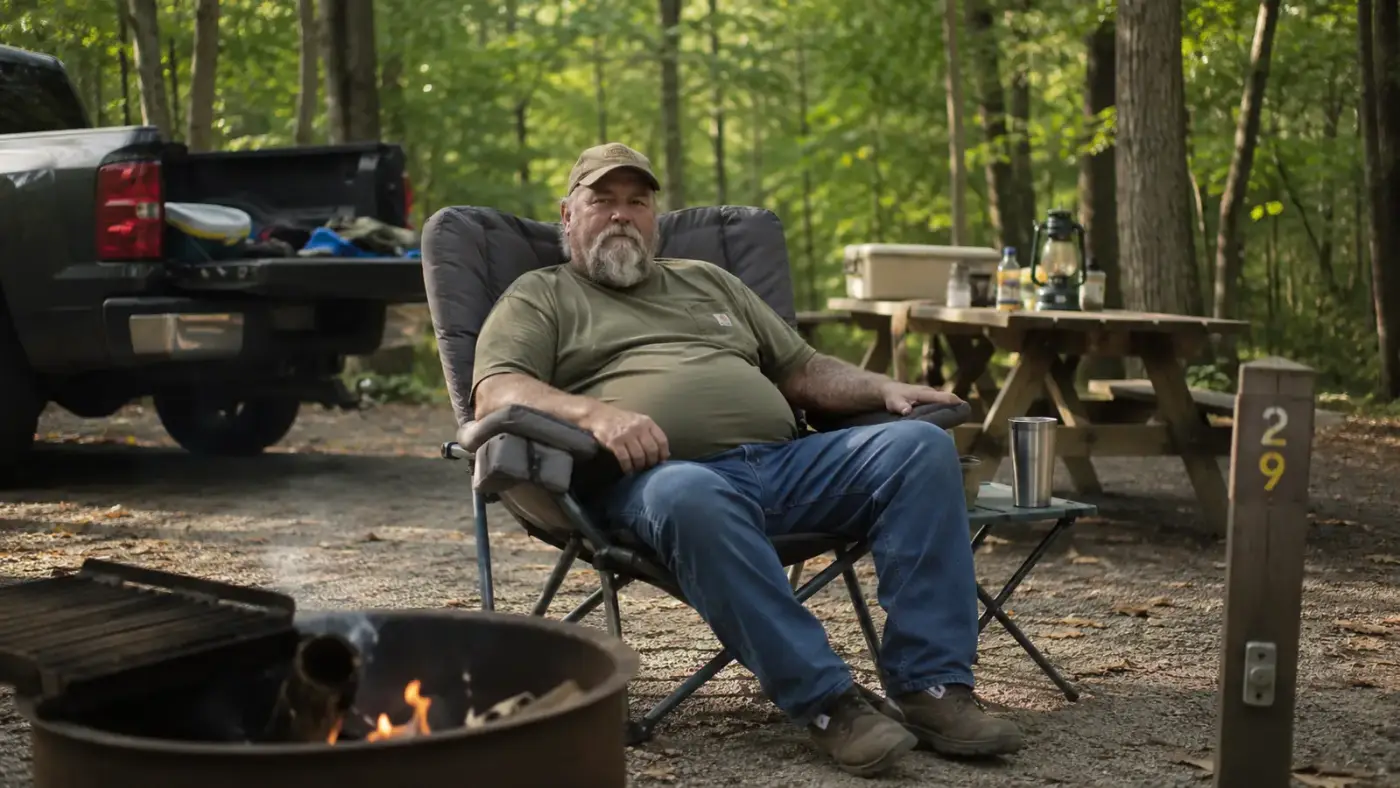
I checked roughly forty occupied campsites a night for nine seasons as a campground host at an Ozarks state park in northern Arkansas, and the single most common piece of broken gear I saw sitting by a fire ring was a camping chair. Not a tent. Not a cooler. A chair, usually with a leg bent sideways or a seam split down the back, usually belonging to someone who never should have bought that particular chair in the first place.
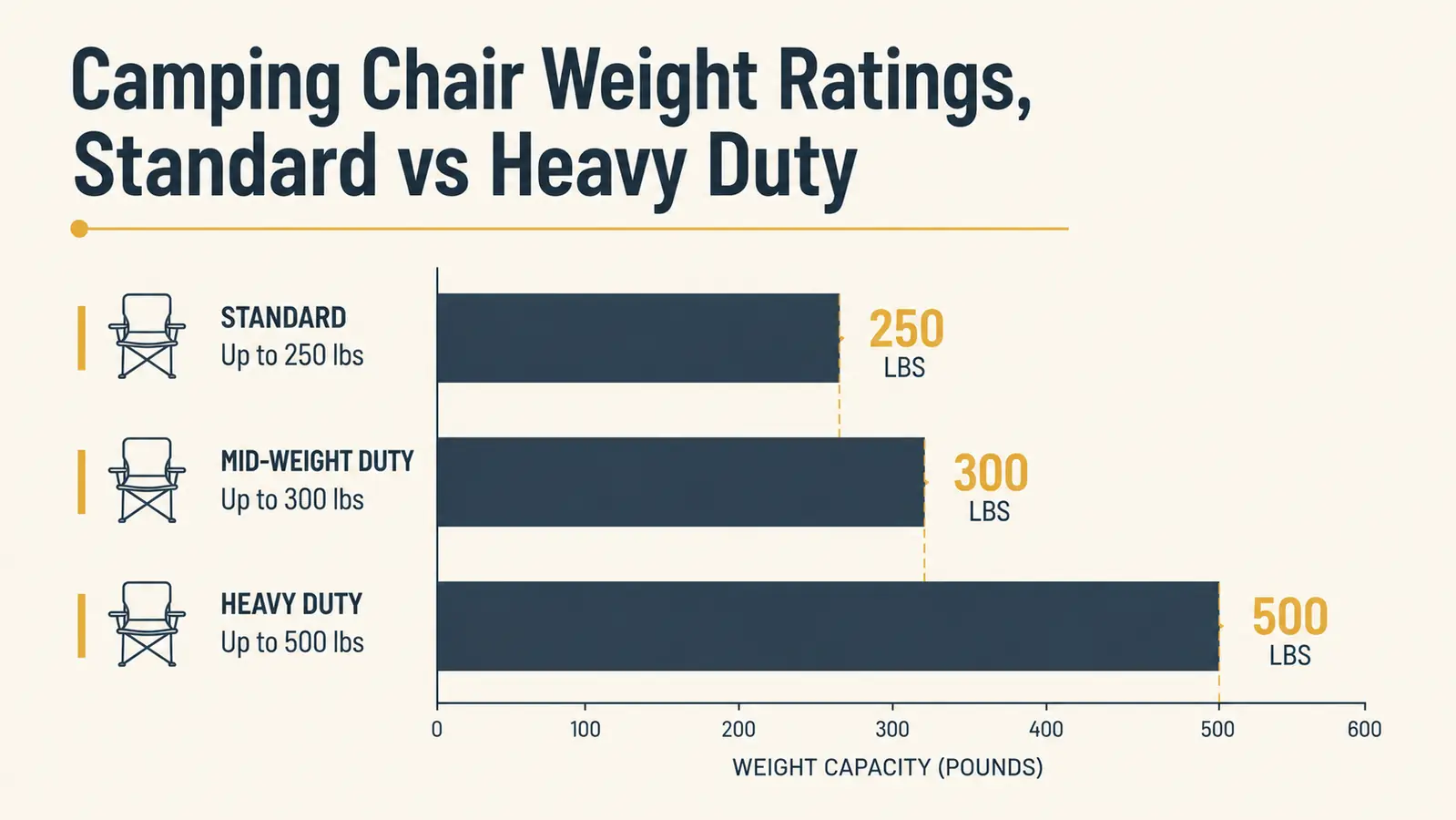
Most folding camping chairs on the market are built for a 250 to 300 pound rider, and plenty of them don't hold even that under real use. If you weigh more than the standard rating, or you just want a chair that won't quit on you by August, you need to shop differently than the average camper. I've spent a full season sitting in the ALPHA CAMP Heavy Duty Camping Chair at my own host site while watching dozens of other chairs fail around me, and this is how I'd walk you through picking one if you were setting up next to me on Loop B.
Skip the guesswork and start with a chair built for it
The ALPHA CAMP Heavy Duty Camping Chair is rated to 500 pounds with a wide steel frame and padded seat, the kind of build I look for in every step below. Check today's price on Amazon before you buy anything else.
Amazon Check Today's Price on Amazon →Step 1: Find the actual weight rating, not the marketing language
Every chair on Amazon says something like heavy duty or extra sturdy in the title. That language means nothing on its own. What you want is a specific number, printed by the manufacturer, usually somewhere in the product title or the bullet points below it. If a listing won't tell you a weight rating in plain numbers, that's a chair I'd walk past, because a company confident in its build tells you the number up front.
I've watched campers assume oversized means heavy duty, and those aren't the same thing. An oversized seat with a standard 250-pound frame underneath it will still fail, it just fails while giving you more room to fall. Look for the rating specifically, not the seat width. The ALPHA CAMP chair I've watched hold up over a full season is rated to 500 pounds, and that number is printed right in the title, not buried in a spec sheet you have to hunt for.
One more thing worth checking here: a real weight rating usually comes with a reason behind it, thicker steel tubing, a wider base, reinforced stitching at the stress points. If a listing just states a big number with nothing else backing it up in the photos or description, be skeptical. I trust a rated chair more when the listing also shows or describes the frame gauge, and I trust it even more when thousands of buyers have left reviews confirming the rating held up rather than just a handful of first-week photos.
Step 2: Look hard at the frame, especially the leg joints
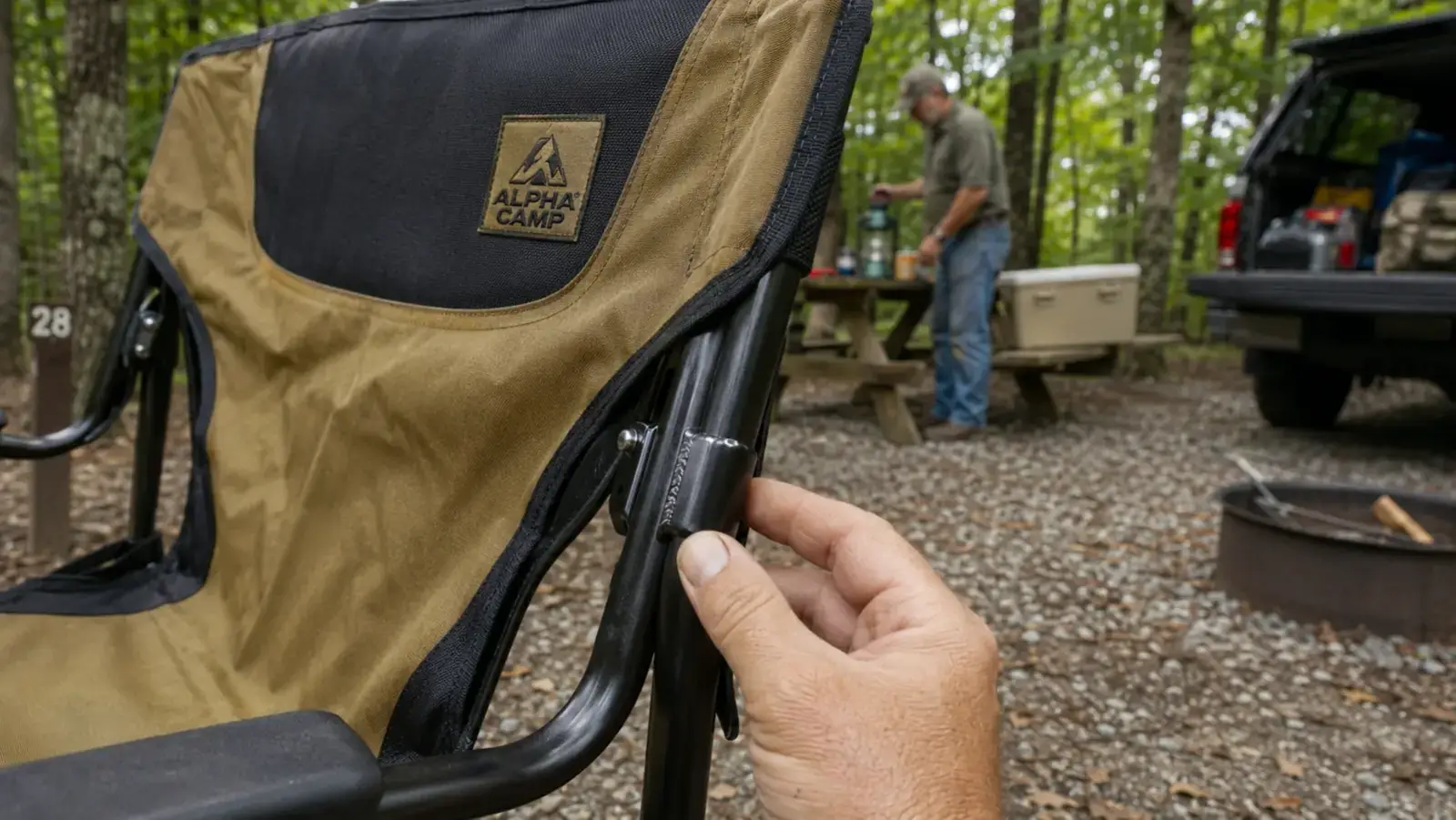
When I check a chair at a campsite, the first thing I look at is the weld where the legs meet the seat frame. That's where I've watched cheap chairs fail, almost always. A hairline crack at a weld doesn't announce itself, it just gets a little worse every time someone sits down, until one night it lets go.
You can't inspect welds through a product photo the way I can in person, but you can read for it. Look for reviews that specifically mention frame durability after months of use, not just a first-week impression. A chair with thousands of reviews and a rating that's held steady over time is more trustworthy than a new listing with a handful of five-star reviews and nothing else to go on. Search the review text for words like months, season, or still holding up, and skip past the reviews that only describe the unboxing.
Also pay attention to how wide the legs sit. A narrow-legged chair will sink a leg into soft dirt or sand faster than you'd expect, and that throws the whole frame off balance even if the weld itself is fine. Loop B had a mix of gravel pads and soft dirt sites, and I watched narrow-stance chairs tip more than once on ground that a wide-stance chair handled without a problem. If you camp anywhere with soft or uneven ground, a wide base matters as much as the frame material.
Step 3: Check the seat height before you check the padding
This step gets skipped a lot, and it shouldn't. A low seat is harder to get up out of, plain and simple, and that's true for anyone, not just bigger campers. I have bad knees from nine seasons of walking gravel loops, and a low, thin chair makes standing up at the end of a long night twice as much work as it needs to be.
Most product listings will give you a seat height in inches. Anything in the 18 to 20 inch range is closer to a dining chair and will be noticeably easier to get in and out of than a low-slung 14 or 15 inch camp chair. If the listing doesn't give a seat height, check the photos for how the chair sits relative to a cooler or a person standing next to it, and use that as a rough guide.
Seat width matters here too, and it's a separate number from the weight rating. A wider seat gives you room without feeling wedged in, which matters more over a three-hour evening at the fire ring than it does for a quick lunch stop. I'd rather sit in a slightly heavier chair with real shoulder room than a lighter one that pinches by the second hour. If the listing gives both a seat width and an arm-to-arm width, compare the two, because some chairs measure wide at the shoulders but pinch in at the hips.
Step 4: Don't skip the padding and fabric, even on a heavy duty chair
A lot of heavy duty chairs put all their engineering into the frame and treat the seat like an afterthought, just a stretched sling of fabric bolted to a strong base. That's a mistake, because a strong frame under a thin seat is still an uncomfortable chair, and comfort is the whole point of sitting down after a day of setting up camp.
Look for a chair with actual cushioning in the seat and back, not just a taut fabric panel. Padding that has some depth to it holds its shape longer under repeated use, where thin foam or a bare fabric sling will go flat or start to sag within a season. I've watched this play out at my own host site: a padded seat still had real loft in it after a full season of near-daily use, while a thinner chair two sites over had already gone flat by midsummer.
Fabric quality matters for the same reason. A campsite is a dirty place, sap, dropped food, campfire ash, and a fabric that wipes clean with a damp rag saves you from replacing a chair over a stain rather than an actual failure. If you want a full read on how one heavy duty chair's padding and fabric held up over an entire season, I wrote up a season-long review of the ALPHA CAMP chair that covers exactly this, including how it looked and smelled by the end of the summer.

Step 5: Be honest with yourself about weight and how you'll carry it
Here's the tradeoff nobody puts on the box. A chair built to hold 500 pounds is not going to be light. The steel that makes the frame trustworthy also makes the chair heavier to carry, usually close to 20 pounds for a serious heavy duty model. That's a fair trade if you're a car camper walking a chair 30 feet from your tailgate to the fire ring. It's a rougher trade if you're hauling gear any real distance on foot.
Think honestly about your own camping setup before you buy. If you drive to your site and unload straight from the truck bed or trunk, weight barely matters, the chair goes 20 or 30 feet and then stays put for the trip. If you're parking in a lot and carrying gear to a walk-in site, or you're trying to fit four chairs plus a cooler and a tent into a compact car, the bulk and weight of a heavy duty chair will cost you something real. There's no getting around that physics, and any listing that claims a 500-pound rated chair is also lightweight and compact isn't being straight with you.
This is also where it's worth deciding how many heavy duty chairs you actually need. If your whole group needs seating, you might mix one or two rated chairs for the bigger campers with lighter standard chairs for everyone else, rather than hauling a full set of heavy frames. For more on why the extra weight is worth it for the person who actually needs the rating, I put together ten reasons an oversized camping chair earns its keep at a real campsite.
Step 6: Check the warranty and how the seller handles a failure
Even a well-built chair can have a bad unit slip through, a weld that wasn't quite right or stitching that missed a pass on the machine. What separates a good buy from a bad one at that point isn't the failure itself, it's what happens next. Look for a listing that spells out a warranty period and a clear way to reach the manufacturer, not just a generic return window handled entirely by Amazon.
I'd also check whether the brand has a track record of standing behind its gear. A company selling thousands of units a year with a warranty program in place has more to lose from ignoring a defect than a no-name listing that might not exist in six months. It's a small thing to check before you buy, but it matters a lot more the one time you actually need it.
What Else Helps
A couple of small things I've picked up from watching hundreds of chairs across a season. Check the folding mechanism in person or in a close-up photo before you buy, a hinge that seizes up after one damp fold will ruin an otherwise good chair fast. And if a chair comes with an attached cooler bag or cup holder, look for whether it's stitched into the armrest or just clipped on. Clipped-on accessories are the first thing I've watched break at other people's campsites, while stitched ones tend to survive a whole season without coming loose.
I have watched a lot of camping chairs die on my loop, almost always the same way, a weld crack or a seam blowout under someone the chair was never built for. Buy the number on the label, not the word heavy duty on the front.
Buy the chair built for the number, not just the name
The ALPHA CAMP Heavy Duty Camping Chair covers every step above: a 500-pound steel frame, wide stance, real padding that holds its shape, and a stitched cooler bag instead of a clip-on. Check today's price on Amazon and see if it's in stock for your next trip.
Amazon Check Today's Price on Amazon →