
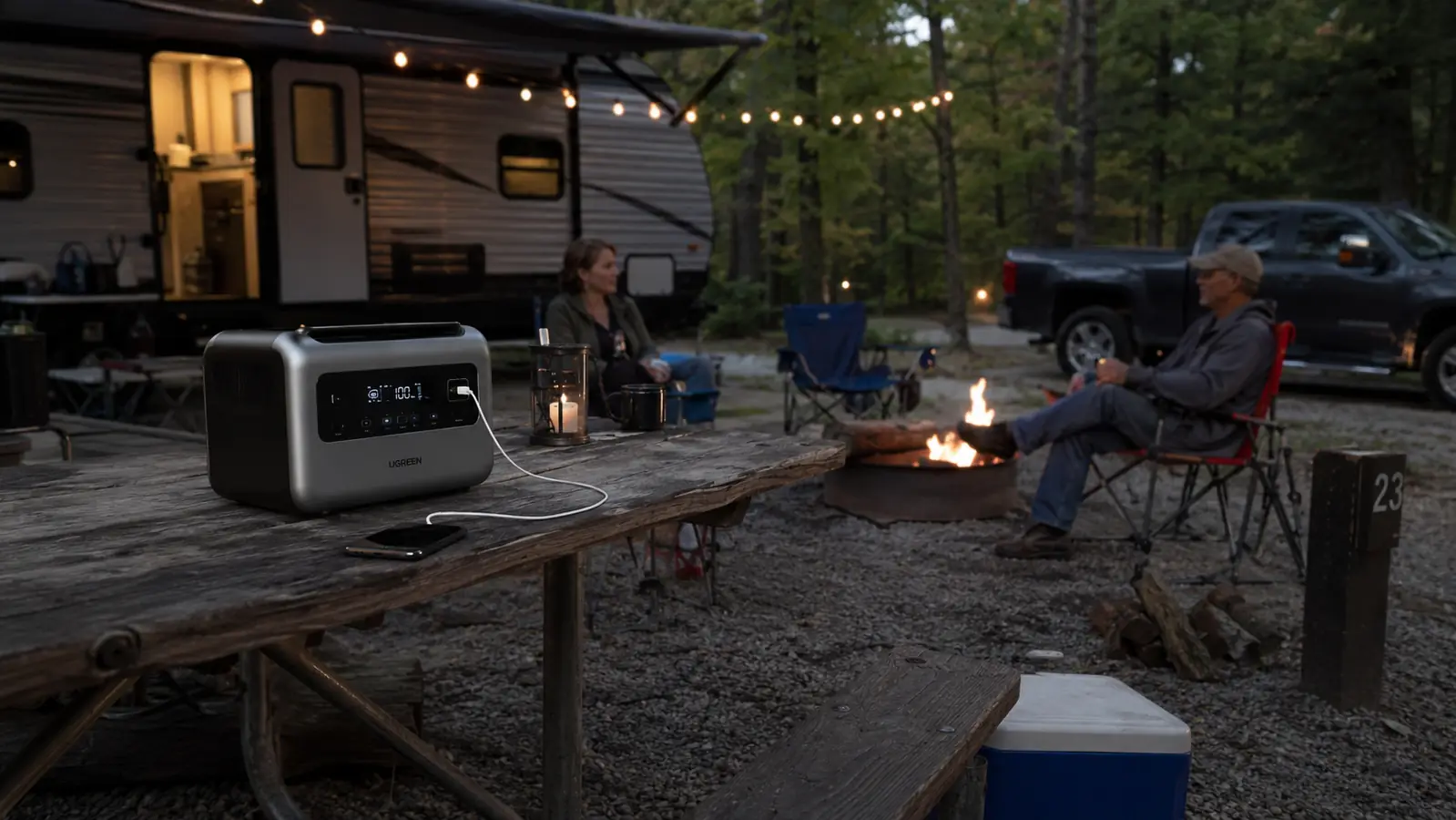
Nine seasons of walking the loop at dusk, and the single most common complaint I fielded as a campground host wasn't a raccoon in a cooler or a fire ring built too close to a tent. It was a generator running past quiet hours. I'd get a knock on my trailer door around 9:15, some tired parent from two sites over asking if I could please go say something, and I'd walk down the gravel road already knowing what I'd find. Sometimes it was an honest mistake, someone who forgot to shut it off after charging a phone. Sometimes it ran all night because a family didn't want their cooler to lose ice. Either way, I was the one who had to walk over and ask them to shut it down, and I did that more times across nine seasons than I can count on both hands. I remember one couple on Site 14 who genuinely had no idea their generator carried that far across the loop until I stood at their picnic table and asked them to listen.
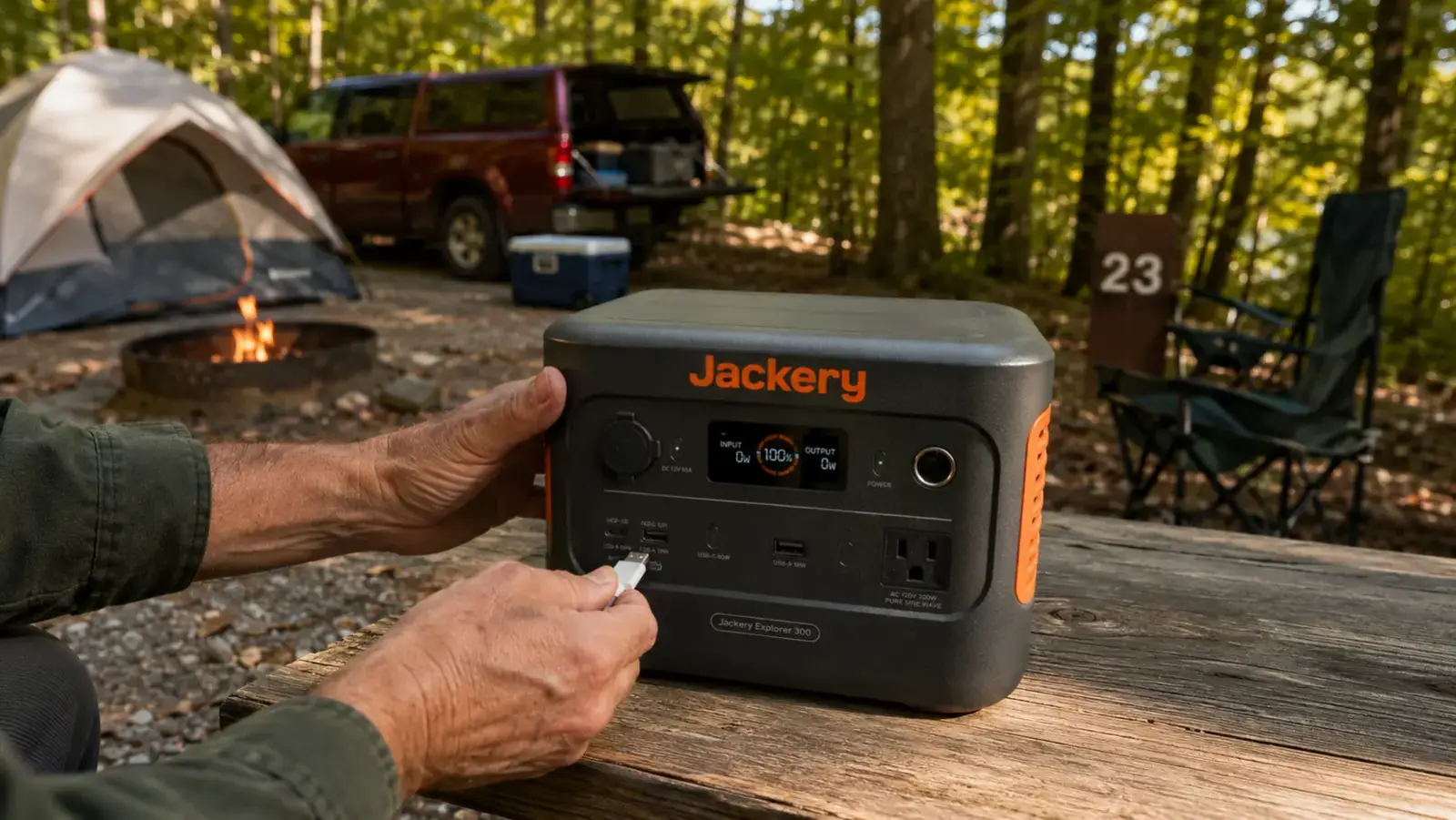
So when I finally bought a Jackery Explorer 300 Portable Power Station for my own site, it wasn't because I'm anti-generator. It's because I watched which one actually made a campground pleasant to be at, night after night, for nine years. This isn't a case where one option is simply better. A gas generator will out-produce the Jackery Explorer 300 on raw, sustained power every time, and I'll say that plainly up front because I've watched this power station run a camper trying to power a space heater all night and fail at it. What follows is an honest comparison of where each one earns its spot at a campsite, and where it doesn't.
| Spec | Jackery Explorer 300 | Gas Generator |
|---|---|---|
| Product | Jackery Explorer 300 Portable Power Station | Typical 2000W Inverter Gas Generator |
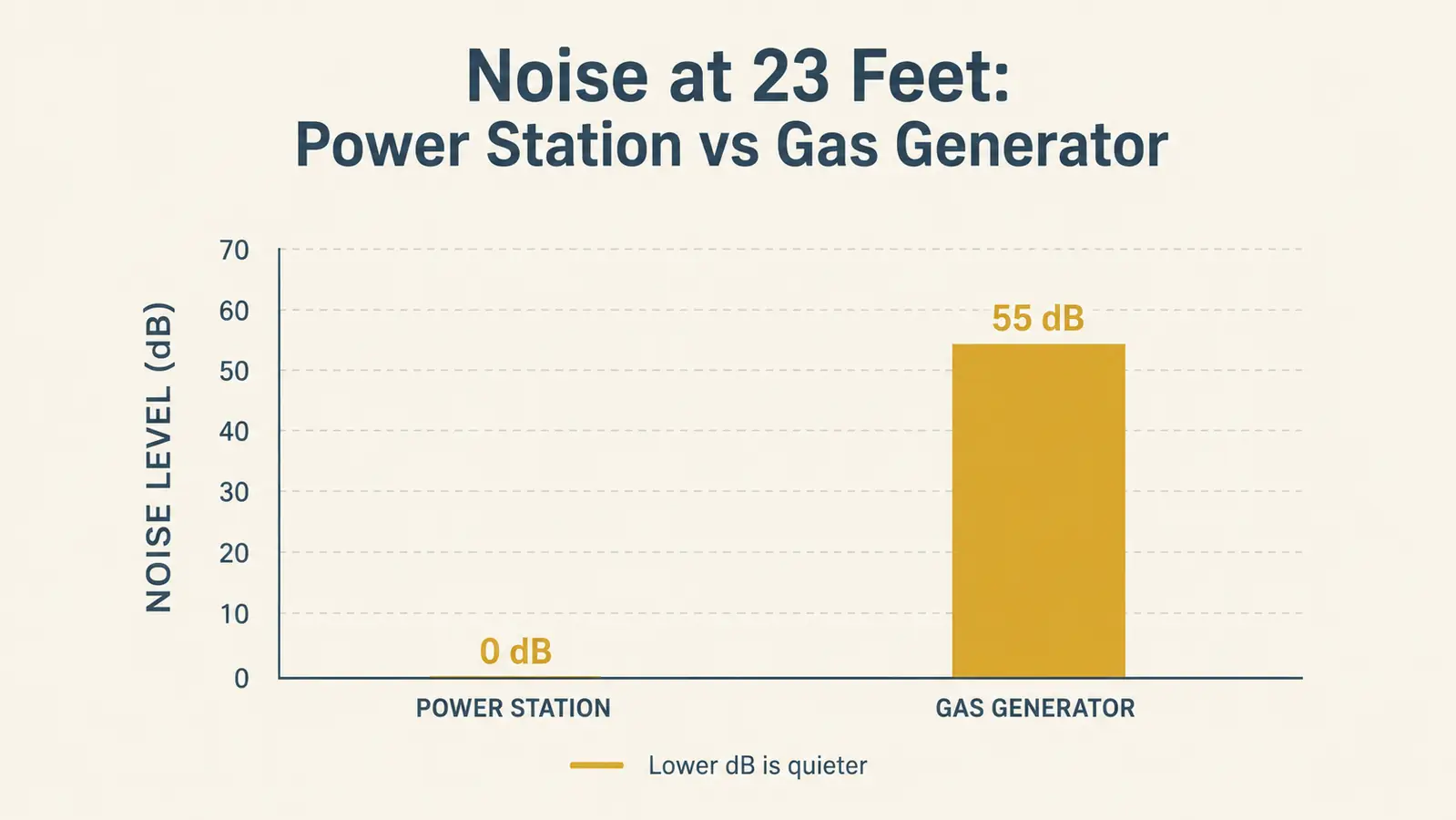
| Noise Level | Silent, no moving parts or combustion | 52 to 59 dB at 23 feet, audible across several campsites |
| Weight | 7.1 lbs, one-handed carry | 40 to 50 lbs, needs a dolly or two people |
| Capacity / Runtime | 293Wh, roughly a full weekend of phones, lights, and a fan on a single charge | 8 to 10 hours per full tank, refuelable indefinitely |
| Sustained High-Draw Output | 300W continuous, not rated for space heaters or a window AC unit | 1,600W or more continuous, runs high-draw appliances for hours |
| Refuel / Recharge Method | Wall outlet, car outlet, or optional solar panel, no fuel to carry | Requires carrying and storing gasoline, plus a stabilizer |
| Safe Near an Enclosed Space | Zero emissions, safe to run inside a tent, camper, or vehicle | Never safe in a tent, camper, vehicle, or any enclosed space, produces carbon monoxide |
| Maintenance | None, no oil, no spark plug, no carburetor to clean | Regular oil changes, fuel stabilization, carburetor upkeep |
| Current Price | Check today's price on Amazon, typically well under $250 | $400 to $1,000+ for a comparable quiet inverter model |
Where the Jackery Explorer 300 Wins
Quiet hours is where this power station earns its keep, and it isn't close. Most state parks and private campgrounds post quiet hours somewhere around 10pm to 7am, and a running generator is the single most common way I watched campers break that rule without even meaning to. They'd start it up at 6am to make coffee, and by the time I walked the loop at 6:45 I'd already have two complaints. The Jackery Explorer 300 makes coffee through an electric kettle or runs a percolator warmer just fine, and nobody two sites over ever knows it's on. I plugged a phone charger into mine more nights than I can count at my host site on Loop B, and never once did a neighbor mention hearing it, because there was nothing to hear.
It also wins on the stuff a generator makes harder than it needs to be. At 7.1 pounds, I can set the Jackery Explorer 300 on a picnic table with one hand while I'm carrying a cooler with the other. A gas generator in the 40 to 50 pound range means a second trip from the truck bed, or wrestling it out with someone's help. There's no fuel to haul, no spill to worry about in the bed of my 2011 Toyota Tacoma, and no gas can taking up space I'd rather use for firewood. I've watched campers forget to bring a stabilizer and end up with gummed-up carburetors the following spring. A battery power station doesn't have that failure mode. You charge it, you use it, you charge it again. I usually top mine off from the truck's outlet on the drive up, so it's sitting at a full charge before I've even backed into the site.
There's also a cost side to this that doesn't show up until you own one for a while. A gas generator needs gasoline every time you run it, and on a busy holiday weekend that can mean two or three trips to a gas station five or ten miles from the campground, plus a stabilizer additive if it's going to sit unused between trips. The Jackery Explorer 300 costs nothing to run beyond the electricity from a wall outlet, and if you add the optional solar panel, it costs nothing at all once you own it. Over a full camping season, I've watched that add up to real money for campers who run a generator every weekend, money that never shows up on the sticker price of the generator itself.
Where a Gas Generator Wins
I have to be straight with you here, because I've watched families learn this the hard way. A gas generator wins on sustained, high-draw power, full stop. If you're running a space heater through a cold night, a window air conditioner in a camper during a July heat wave, or a full-size coffee maker and a mini fridge at the same time, a 293Wh unit like the Jackery Explorer 300 is not going to get you through it. I watched a camper try to run a space heater off a similarly sized power station on a 38-degree night, and it tapped out well before sunrise. A generator, refueled once or twice, will run that same heater all night without blinking.
A generator also wins on runtime that doesn't depend on a wall outlet. If you're camping somewhere without hookups for four or five days straight, a gas generator refueled from a can will keep going as long as you keep bringing gas. The Jackery Explorer 300 needs to be recharged, either from a vehicle outlet, a campground power pedestal, or an optional solar panel, and if none of those are available for several days, you're managing your battery budget carefully. For short weekend trips that's rarely an issue. For a longer stay off the grid, it's the real tradeoff, and I won't pretend a 293Wh battery replaces a generator for that kind of trip. Anyone planning a week at a primitive site with no hookups should think hard about that before leaving the power station as their only option.
The Safety Difference Nobody Should Skip
I'm going to say this as plainly as I know how, because I checked campsites for nine seasons and I've seen how close this comes to going wrong. A gas generator must never be run inside a tent, a camper, a vehicle, or any enclosed space, not even with the door cracked or a window open. Gas generators produce carbon monoxide, an odorless gas that kills campers every single year, including experienced ones who thought a partly open door was enough ventilation. It isn't. If you run a generator, it needs to sit well outside and away from any sleeping space, tent flap, or camper window, full stop, no exceptions. A battery-powered carbon monoxide detector inside your tent or camper is cheap insurance, but it is never a substitute for keeping the generator outside and away from where you sleep in the first place.
I checked roughly forty occupied campsites a night for nine seasons, and generator placement was one of the things I looked at every single walk, right alongside fire ring safety. Most campers get it right. But I've also walked up on a generator running a few feet from a tent flap on a cold morning, and that conversation is not one I ever want to have again. The Jackery Explorer 300 has no combustion and produces zero emissions, which means this entire category of risk simply doesn't exist with it. That alone is worth factoring into your decision even before you get to noise or weight.
Ready for quiet power that won't get a complaint knocked on your door?
The Jackery Explorer 300 Portable Power Station runs your phone, lights, and small devices without a single decibel of noise or a drop of gasoline. Check today's price on Amazon before your next trip.
Amazon Check Today's Price on Amazon →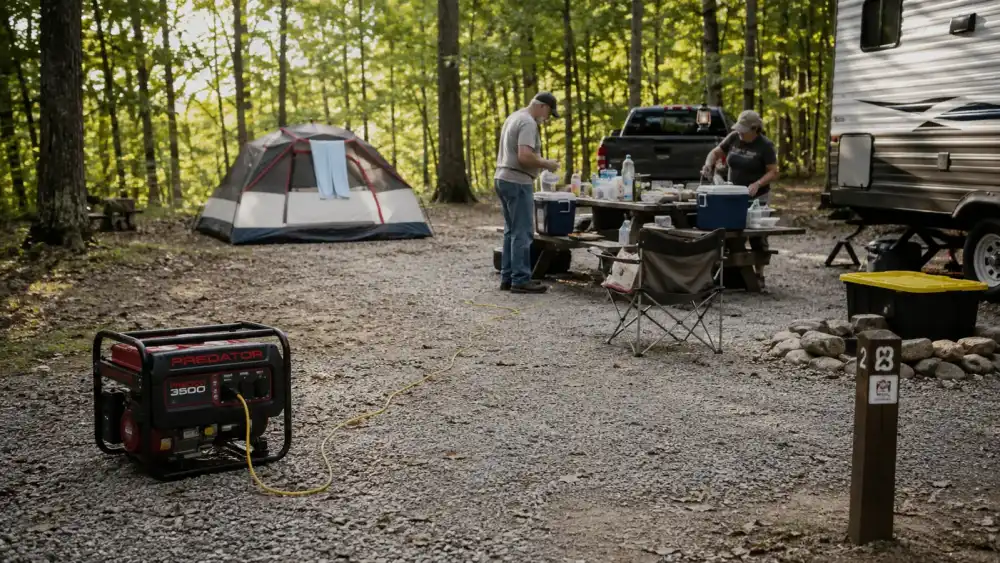
Who Should Buy Which
If you're a weekend car camper who wants to keep phones charged, run a fan or a string of camp lights, power a CPAP machine overnight, or top off a laptop between trail photos, the Jackery Explorer 300 is the better buy, and it isn't close. It's quiet, it's light enough to move around the site without a second person, and it never puts you at risk of carbon monoxide near your tent or camper. I've used mine at my own site for exactly this kind of load, and it's covered every evening I've asked it to, including a few nights I ran a string of camp lights, a fan, and two phones charging at once without the battery blinking a warning.
If you regularly run a space heater through cold nights, need a window AC unit for a camper during summer, or you're camping off-grid for a week or more without hookups, a gas generator is the more honest tool for that job, and I won't tell you otherwise. Just plan on running it well away from any tent or camper, never inside or even in a garage-style enclosure, and budget for the noise and the maintenance that come with it. Most campers I checked in on over nine seasons landed somewhere in between: they kept a generator for the rare high-draw trip and used a power station like the Jackery Explorer 300 for every ordinary weekend, which is honestly the setup I'd recommend if your budget allows for both.
If you want the fuller picture of how this power station performs over repeated trips, I wrote up a long-term review after months of using it at my host site, and a separate piece on the specific ways it's earned its spot in my truck bed. Between those two and this comparison, you should have everything you need to decide whether the Jackery Explorer 300 fits the way you actually camp, or whether a generator is the more honest tool for your trips.
Skip the fuel cans and the quiet hours complaints
For most weekend campsite power needs, the Jackery Explorer 300 does the job a generator does, minus the noise, the maintenance, and the carbon monoxide risk. Check today's price on Amazon and see if it fits your next trip.
Amazon Check Today's Price on Amazon →