
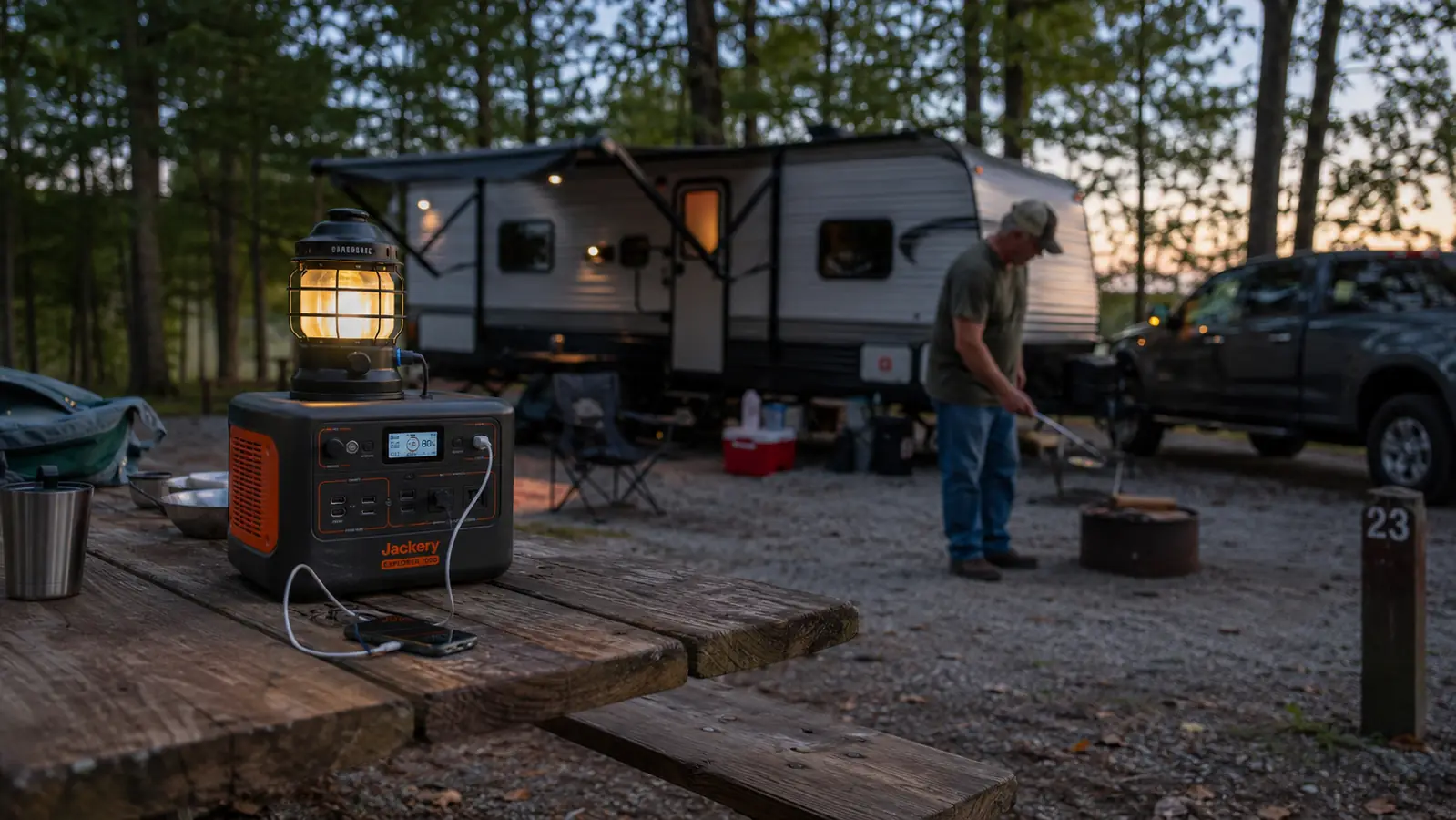
I've watched campers try to run space heaters off gas generators at two in the morning, generators loud enough that I could hear them from three sites away on my walk through the loop. I've also watched the opposite problem more times than I can count: families whose phones died by the second day because nobody packed a way to charge anything besides the car's dashboard outlet. Nine seasons working a campground loop in the Ozarks, checking roughly forty occupied sites a night from April to October, taught me that most power problems at a campsite aren't about running big appliances. They're about keeping small things charged, quietly, without waking up the site next door. That's the gap the Jackery Explorer 300 portable power station is actually built to fill, and after running one at my own host site for a full season, I can tell you exactly where it earns that job and where it doesn't.
This isn't a chair or a stove I could hand off to a neighboring camper overnight and watch what happened to it. A power station mostly lives at your own site, so most of what I know about the Explorer 300 comes from my own use, not from watching other families' units fail the way I've watched chairs and stoves fail on this loop. I ran it at my host site on Loop B for a full season, April through October, charging it off wall power in my trailer between busy stretches and running it back down on everything from a CPAP machine to a string of camp lights. This is that season, laid out honestly, flaws included.
The Quick Verdict
A genuinely useful, quiet power source for keeping small electronics and low-draw devices charged through a multi-day trip, as long as you're realistic about what 293 watt-hours can and can't run.
Amazon Check Today's Price →Tired of your phone dying by the second day at the campsite?
The Jackery Explorer 300 is a 293 watt-hour LiFePO4 power station that recharges phones, laptops, lanterns, and other small devices without a loud gas generator running all night. Check today's price on Amazon before your next trip.
Amazon Check Today's Price on Amazon →How I've Used It
The routine settled fast. The Explorer 300 charged overnight off the wall outlet in my trailer, then came out to the picnic table most mornings so I could top off my phone before the first round of check-ins. In the evenings it sat next to my chair at the fire ring, running a small LED lantern for hours at a time and topping off whatever camera or radio battery had drained that day. None of that comes close to draining a 293 watt-hour battery. It's the kind of use this unit was clearly designed for, and it never once let me down on it.
The heaviest single draw I put on it regularly was my own CPAP machine, which pulls more overnight than any other device I own. A full night on the CPAP alone used a real chunk of the battery, somewhere around a third of the total capacity depending on pressure settings, which meant I couldn't run the CPAP and also count on a full day of phone charging and lantern use without topping the unit back up. That's not a flaw in the Jackery so much as basic math on 293 watt-hours, but it's the kind of thing I wish someone had told me plainly before I bought one, so I'm telling you now.
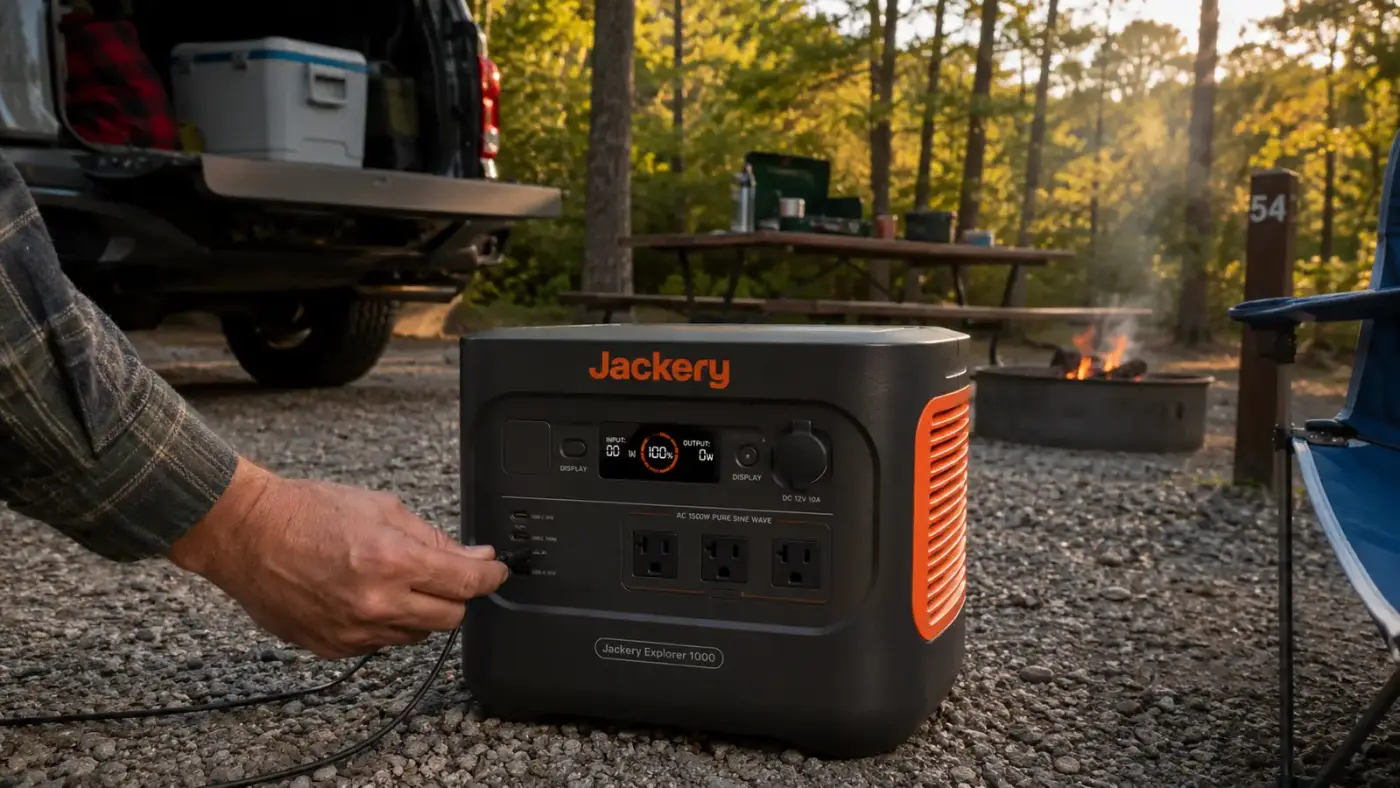
I also hauled it in the bed of my Tacoma a handful of times when I helped set up for weekend events on other loops, running string lights and a small speaker off it for a few hours at a time. It handled that without complaint, and the built-in handle makes it easy to move one-handed, which matters when the other hand is full of extension cords.
What 293 Watt-Hours Actually Powers
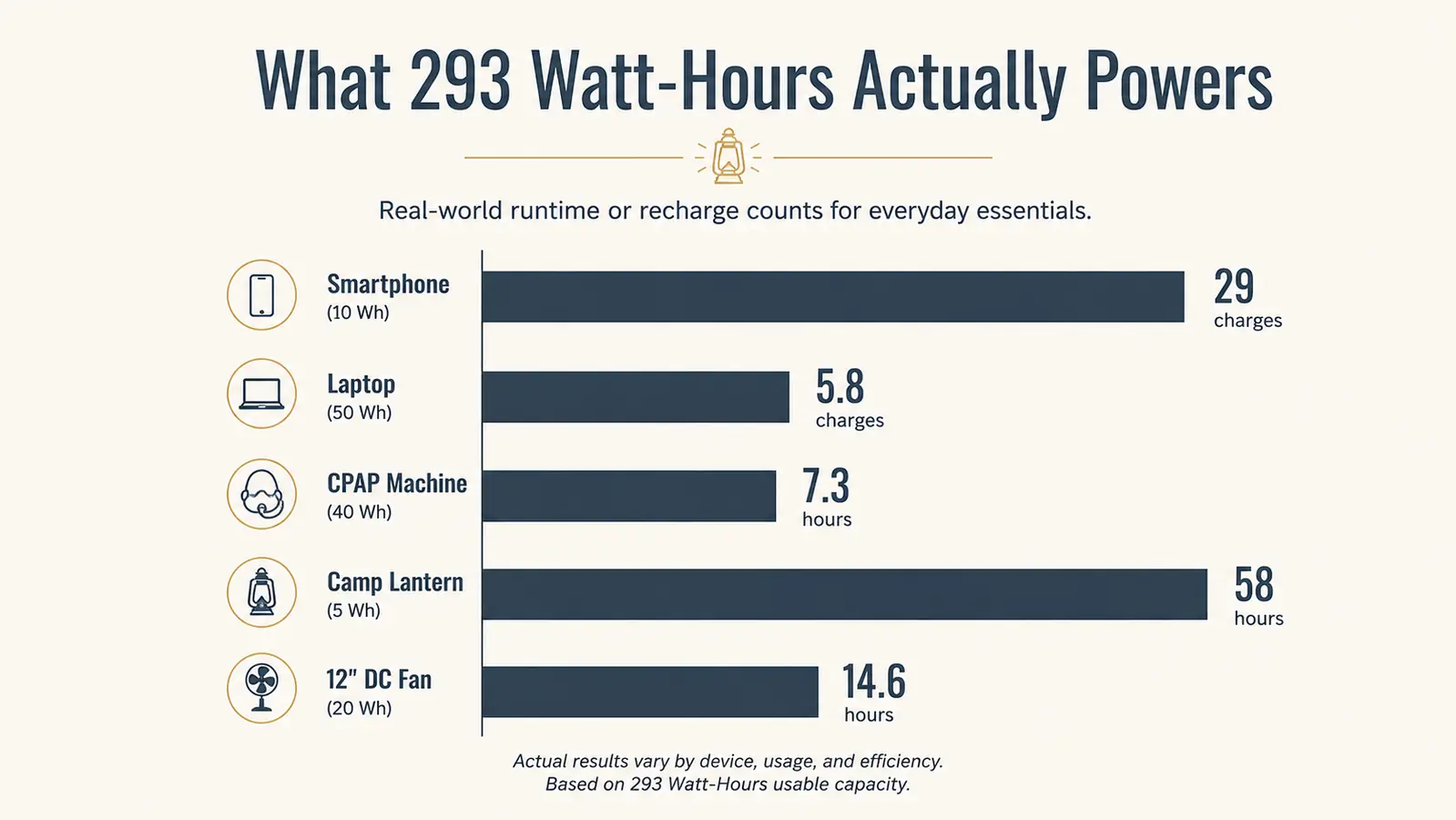
I want to be specific here because vague promises are how people end up disappointed with these units. In my own use, a full charge on the Explorer 300 was good for roughly fifteen to twenty phone charges, four or five laptop charges, one full night on a CPAP machine, or a small LED lantern run for well over twenty hours straight. A box fan on low pulled from it comfortably for an entire hot afternoon. Drone and camera batteries barely register against 293 watt-hours, you could top off a dozen of them and still have most of a charge left. If your camping power needs look like that list, this unit covers them with room to spare.
Where people get into trouble is assuming a portable power station this size can run a real refrigerator. It can't, and I want to be straight about that instead of letting the box art do the talking. I did run a small 12-volt cooler off it a few times, the kind that pulls somewhere around 40 to 50 watts, and got a solid five or six hours out of it before I needed to plug back in or move to shore power. That's fine for an afternoon at the site, but it is nowhere close to keeping a cooler running unattended overnight, and it is not the same thing as a full-size fridge with a compressor cycling on and off all day.
Don't buy this expecting it to run a full-size refrigerator, a window air conditioner, a space heater, or a coffee maker with a heating element. Those draws are far beyond what 293 watt-hours was ever meant to handle, and I've seen campers plug in something like a space heater, watch the unit shut off or drain in twenty minutes, and blame the battery when the math was against them from the start. This is a small-electronics and low-draw-appliance power source, not a house-current replacement, and it earns its 4.5 stars for doing that job well, not for pretending to do a job it was never built for.
Charging It Back Up: Wall, Car, and Solar
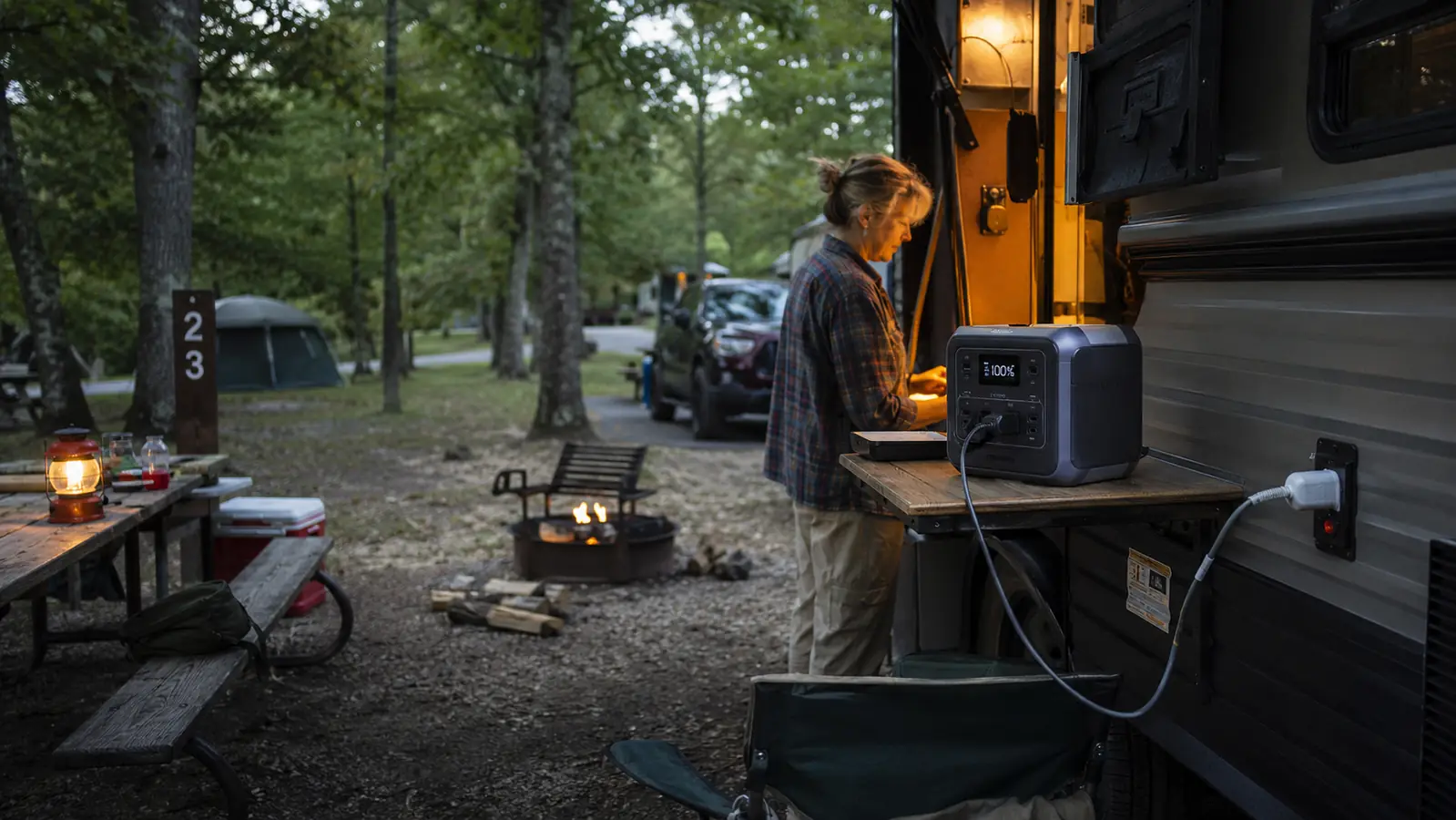
Most of my recharging happened off wall power in the trailer, and a full charge from empty took a little under two hours on the fast-charge setting, which is quick enough that I could run it down at the fire ring and have it topped off again before the next evening. That turnaround made it easy to keep in near-constant rotation across a whole season without ever feeling like I was waiting on it.
For the drive between assignments, the car charging cable worked fine off the Tacoma's 12-volt outlet, though it's slower than wall power and I wouldn't count on a full recharge from a short drive alone. I never bought the optional solar panel Jackery sells alongside this unit, so I can't speak to solar charging firsthand, and I'd rather tell you that plainly than guess. If solar charging is the main reason you're considering this unit, look for a review that's actually tested that panel before you buy on the assumption that it works a certain way.
Battery Performance Across a Full Season
This unit uses LiFePO4 battery chemistry, which held up noticeably better than the lithium-ion units I'd seen other campers run through a season. I used mine most days from April through October, discharging and recharging it dozens of times, and by the end of the season it still charged to what felt like a full capacity and ran devices for close to the same amount of time it did in April. I didn't run a lab test on it, but as someone who's watched a lot of battery-powered gear fade fast by midsummer, this one held up better than I expected.
Temperature never gave it trouble either. It sat through cold mornings on the picnic table with frost still on the grass and through hot afternoons in the bed of my Tacoma with the tonneau cover down, and I never noticed a drop in performance either direction. That matters more than people think, because a lot of battery gear I've watched fail at this campground failed specifically because someone left it baking in a closed vehicle on a ninety-degree day.
Noise, Safety, and Site Etiquette
The biggest quality-of-life difference between this and a gas generator is silence, and after nine seasons of enforcing quiet hours on this loop, I can't overstate how much that matters. A power station like this one makes no noise at all, which means you can charge devices at ten at night without a single complaint from the site next door. I fielded more noise complaints about gas generators than about almost anything else on this loop, usually from campers who ran them well past quiet hours because they didn't have another way to keep a phone or a CPAP charged.
It's also worth saying plainly that a battery power station is not a generator substitute for anything that burns fuel, and you should never run a fuel-burning device indoors or in a tent regardless of what's powering your other gear. If you're weighing this against a traditional gas generator for your specific setup, I wrote a full side-by-side comparison of a battery power station against a gas generator that goes into the tradeoffs in more depth than I can cover here.
Where It Struggled
No product earns a perfect score from me, and this one has real limits beyond the wattage ceiling I already covered. The number of ports is limited, two AC outlets, a couple of USB ports, and a car outlet, which is plenty for one campsite's worth of small devices but gets tight fast if you're trying to run a lantern, a fan, a CPAP, and charge three phones all at once. I had to unplug something to plug in something else more than once during a busy weekend.
The other honest tradeoff is that you're paying for battery capacity and portability, not raw power. If your camping setup genuinely needs to run higher-draw appliances for hours at a stretch, this size unit is going to leave you wanting more, and stepping up to a larger capacity model or a different power source entirely is the more honest answer than trying to stretch 293 watt-hours further than it goes.
What I Liked
- Runs completely silent, no generator noise and no quiet-hours complaints from neighboring sites
- LiFePO4 battery held its charge capacity through a full season of near-daily use
- Recharges to full in under two hours off a standard wall outlet
- Comfortably covers phones, laptops, a CPAP, camp lights, fans, and camera or drone batteries
- Compact and light enough to move with one hand between the trailer and the fire ring
Where It Falls Short
- 293 watt-hours will not run a full-size fridge, an air conditioner, a space heater, or a coffee maker with a heating element
- Only a handful of ports, which gets tight when several devices need power at the same time
- A full night on a CPAP machine alone uses roughly a third of the total capacity
- I never tested the optional solar panel, so I can't vouch for solar recharging firsthand
I've fielded more noise complaints about gas generators on this loop than almost anything else. A power station like this one solves that problem just by being silent.
Who This Is For
This is the right power source for car campers and campground campers who need to keep phones, laptops, a CPAP, camp lights, or small electronics charged across a multi-day trip without running a generator. It's a strong fit for anyone who values quiet at their site, or who camps somewhere with posted quiet hours the way this park has always enforced. If your power needs top out at the devices I've listed here, the Explorer 300 covers them with capacity to spare and never once left me stranded over a full season of daily use.
Who Should Skip It
If you're hoping to run a real refrigerator, an air conditioner, a space heater, or any high-draw appliance for hours at a time, this size unit isn't built for that job and no amount of careful use will change the math. I'd also skip it if you only need power for one weekend a year and don't want to spend on capacity you'll rarely use, a simple battery pack or your vehicle's outlet might cover you fine. For a more blunt breakdown of the tradeoffs, including a few things I only noticed after months of daily use, I put together an honest review covering what nobody tells you upfront.
Ready to stop running out of power at the campsite?
After a full season of daily use at my host site, the Jackery Explorer 300 is the power station I'd buy again for keeping small electronics charged without a generator. Check today's price on Amazon and see if it's in stock for your next trip.
Amazon Check Today's Price on Amazon →