
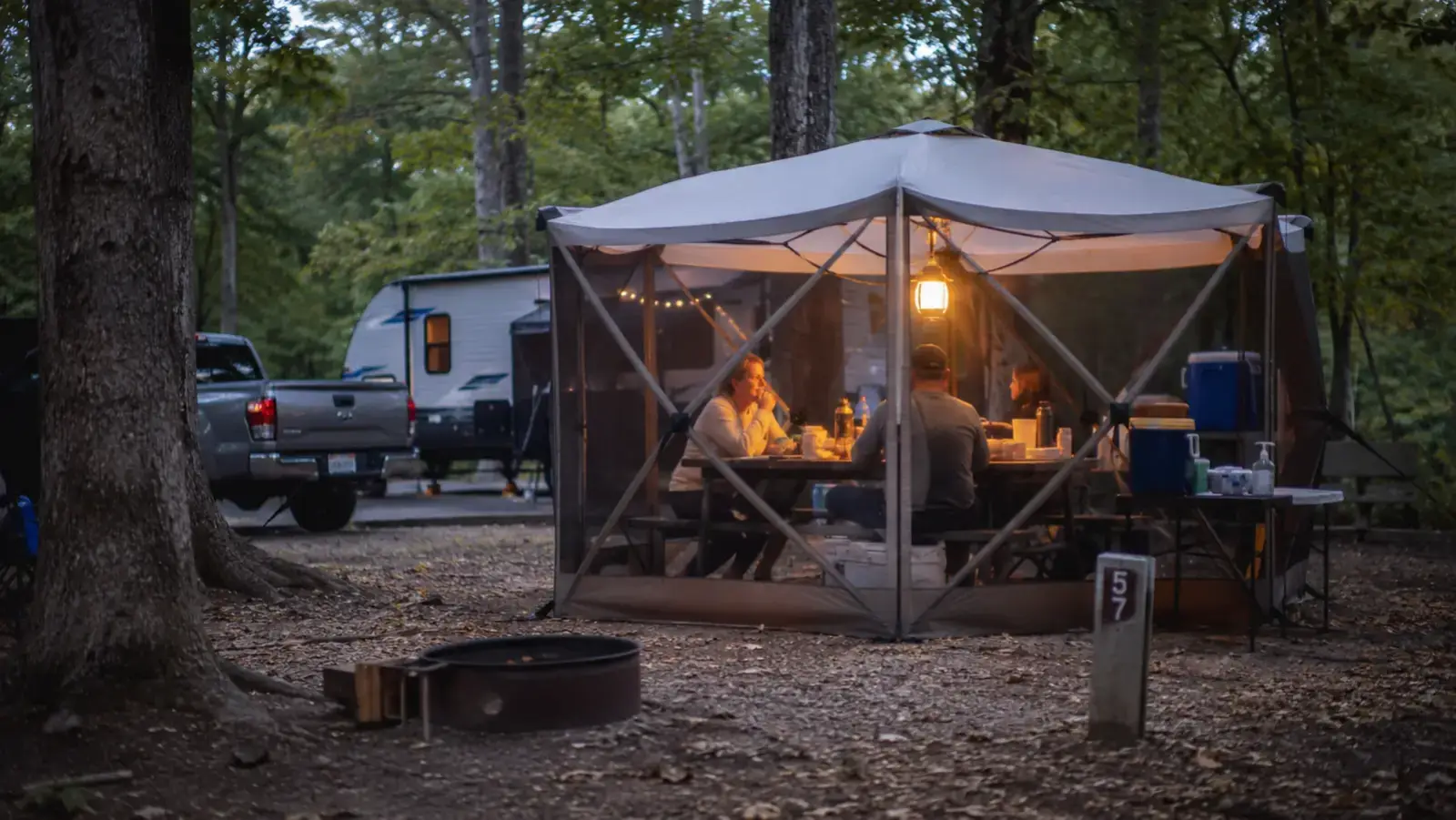
I've spent nine seasons walking the loop at an Ozarks state park in northern Arkansas, checking roughly forty occupied campsites a night from April to October, and two shelter styles show up on tailgates more than anything else: a pop-up screen house and a basic dining fly tarp staked out over the picnic table. This season the Alvantor Pop Up Screen House Tent is the one that ended up outside my own trailer door on Loop B, and after running it against the dining fly tarps I've watched dozens of families use over the years, I can give you the short answer up front. If bugs are your actual problem at camp, the screen house wins outright. If wind, packed size, and price are your problem, the tarp still has a real case.
Neither shelter beats the other on every count, and I'd be lying if I told you it did. A dining fly tarp costs less, packs down to nothing, and shrugs off wind that would have a screen house's mesh walls snapping like a loose sail. What a tarp can't do is keep the bugs off you at dusk, and on my loop that was the single most common complaint I heard at the fire ring, night after night, for nine straight seasons. That tradeoff is what this whole comparison comes down to, so let's look at the numbers before I tell you which one I'd actually buy.
This isn't a spec-sheet argument pulled off a manufacturer's page. I've watched both shelters actually fail at real campsites over the years, mesh walls flapping loose after a gust worked a stake free, tarp corners sagging until a puddle formed and dumped into someone's lap around midnight. That kind of hands-on wear across hundreds of other campers' gear over nine seasons is worth more to me than any owner's manual, and it's what the numbers below are built on.
| Spec | Alvantor Screen House | Dining Fly Tarp |
|---|---|---|
| Current Price | Mid-range, roughly $140 at today's price | Budget, often well under $50 |
| Packed Size | Duffel bag about 4 feet long, needs real trunk or truck bed space | Stuff sack about the size of a rolled sleeping bag |
| Setup Time | Under a minute, pop-up frame snaps into shape on its own | 10 to 15 minutes with poles, guylines, and stakes done right |
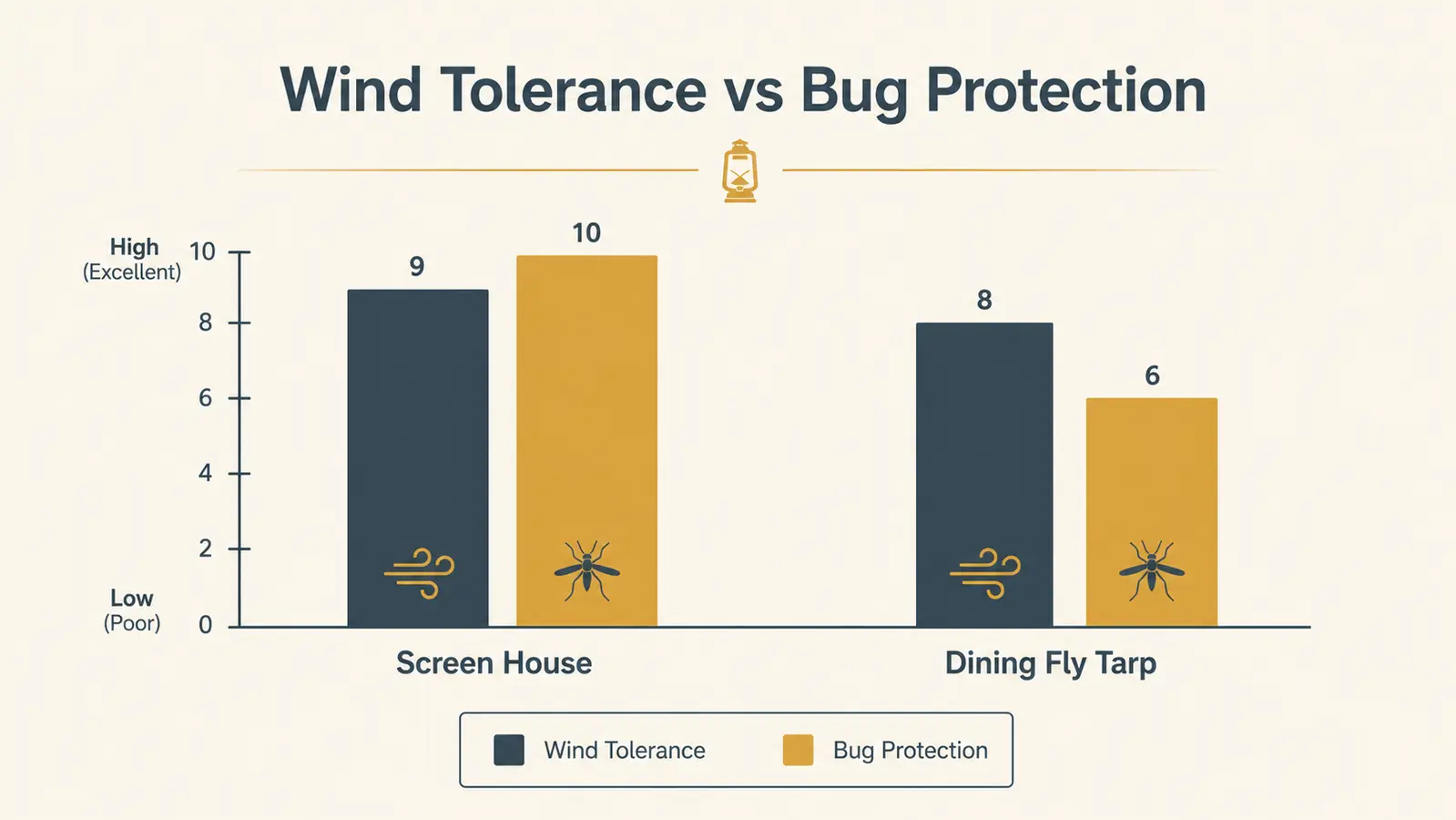
| Bug Protection | Full zippered mesh walls on all sides, keeps mosquitoes and gnats out at dusk | None, the sides are open, bugs move through freely |
| Rain Protection | Solid roof panel, but mesh walls let wind-driven rain blow in sideways | Full waterproof coverage when pitched steep and staked tight |
| Wind Tolerance | Starts struggling past 15 to 20 mph, tall boxy shape catches gusts | Handles 25 to 30 mph gusts when pitched low and taut |
| Shade Coverage | UPF 50+ roof shades the whole enclosed space all day, from any sun angle | Shade only directly under the panel, shrinks and shifts as the sun moves |
| Packed Weight | Around 35 pounds in its carry bag | Under 10 pounds rolled up |
Where the Alvantor Screen House Wins
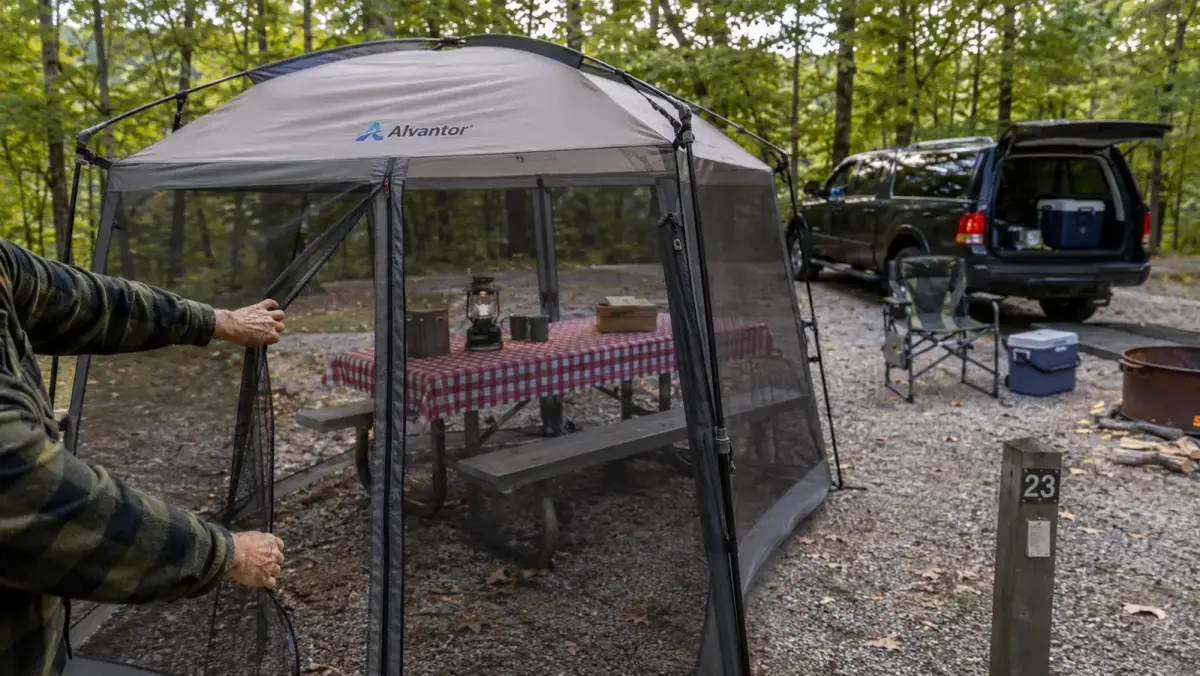
Bugs are the reason most campers on my loop eventually gave up on a bare picnic table and bought a screen house. I watched it happen the same way most seasons. A family sets up with nothing but a tarp over the table for their first couple of nights, dusk rolls in, and by the third evening somebody's slapping mosquitoes through dinner and asking me if the park sprays for bugs. The Alvantor's zippered mesh walls solve that problem completely. You zip the door shut behind you and you're sitting in a lit, bug-free room with a table in it, which a tarp simply cannot offer no matter how you pitch it.
Setup speed is the other place the screen house pulls ahead, especially for anyone rolling into a site after dark, which happens to a lot of families on a Friday night drive. The Alvantor pops open in under a minute, no poles to thread and no guylines to tension in the dark with a headlamp. I've watched campers still fumbling with a tarp's corner stakes twenty minutes after arrival while a neighbor with a pop-up screen house was already inside eating dinner. If you've read my full season-long review of this screen house, that setup speed held up every single time I used it, not just on the first try out of the box.
Shade is the third win, and it's a bigger deal than most first-time buyers expect. The Alvantor's UPF 50+ roof covers the entire enclosed space, so you get shade all day regardless of which direction the sun swings. A dining fly only shades whatever is directly under its single panel, and as the sun moves across an afternoon, that patch of shade crawls right off your table. I've watched campers drag their chairs three separate times in one afternoon chasing a tarp's shrinking shadow. Nobody does that under a screen house.
There's a smaller thing I didn't expect to matter as much as it does, and that's noise. A dining fly's fabric snaps and pops in even a light breeze, and I've had campers on my loop tell me a neighbor's tarp kept them up two sites away. The Alvantor's enclosed walls cut that racket down considerably, since there's far less loose fabric out there flapping in the open air. It's not why anyone sets out to buy a screen house, but after enough restless nights next to a snapping tarp, I understand why some campers switch.
Where a Dining Fly Tarp Wins
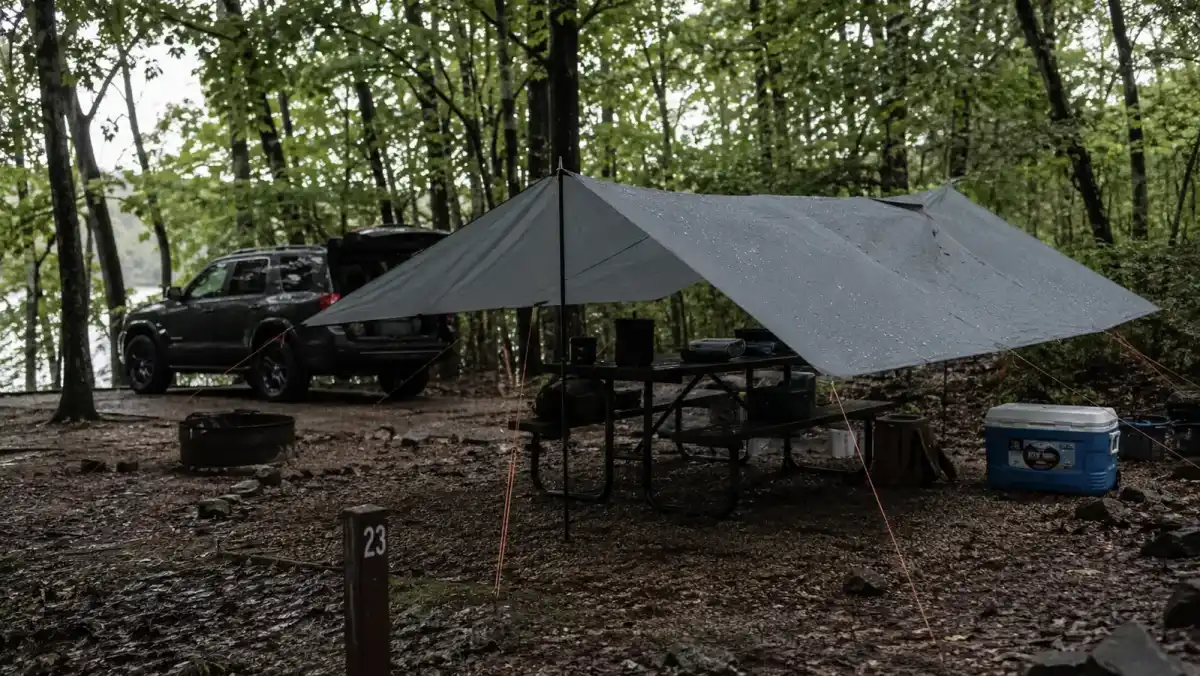
Rain is where the tarp earns its keep, and I won't pretend otherwise. A dining fly, pitched steep with the corners staked low and taut, sheds a hard rain completely, because the whole thing is one continuous waterproof panel with nowhere for water to get in. The Alvantor's roof is solid too, but its walls are mesh, and mesh does not stop wind-driven rain. I sat through an August storm on Loop B where the rain came in sideways for twenty minutes, and everyone inside a mesh-walled screen house that night got wet along the windward wall while the tarp campers two sites over stayed bone dry.
Wind is the second real advantage, and it's connected to the same weakness. A screen house is tall and boxy, which gives it that roomy stand-up interior, but that same shape catches wind like a box kite. I've watched one lift a leg clean off the ground in a gust and drag sideways across a gravel pad before anyone got to the guylines. A dining fly, pitched low and tight, has almost nothing for the wind to grab. I've seen tarps ride out 25 to 30 mph gusts on exposed sites where a screen house would need extra staking just to stay put, or shouldn't be out at all.
A dining fly is also more versatile than people give it credit for. Because it's just a panel and a set of poles, campers on my loop have used the same one to shade a boat launch, cover a stack of firewood through a rainy week, or rig extra coverage over a tent vestibule when a storm rolled in overnight. A screen house is a single-purpose structure. Once it's up, it's a room, and it isn't coming down and going back up somewhere else on the same trip without real effort.
Then there's price and packed size, which matter more than people admit until they're loading a small trunk for a weekend trip. A basic dining fly costs a fraction of the screen house's current price and rolls down to about the size of a sleeping bag, versus a duffel that eats real trunk space. If you already own tarp poles from years of camping, or you're working with a compact car instead of a truck bed, that difference is worth reading my list of reasons I'd still choose the screen house anyway before you decide, because the tradeoff isn't as simple as price alone.
Tired of losing the evening to mosquitoes at the picnic table?
The Alvantor Pop Up Screen House Tent sets up in under a minute and gives you a full mesh-walled room where the bugs can't reach you. Check today's price on Amazon before your next trip.
Amazon Check Today's Price on Amazon →A screen house can't out-argue a tarp in 30 mile-an-hour wind, and a tarp can't keep a single mosquito off your ankles at dusk. Pick your fight before you buy.
Who Should Buy Which
For most campground campers, the Alvantor screen house is the better buy, and it's the one I run at my own site. Most trips I watched on my loop over nine seasons weren't fighting 30 mph wind, they were fighting mosquitoes at dusk and a sun that wouldn't sit still over the picnic table, and that's exactly the fight the screen house wins. If your usual campground has any tree cover to break the wind, and your trunk or truck bed has room for one more bag, I'd buy the screen house without hesitating.
The dining fly tarp still makes sense in specific situations, and I'd tell you straight that it's the smarter buy in them. If you camp exposed, coastal sites, high ridgelines, open prairie campgrounds where the wind never really stops, a tarp pitched low is going to outlast a screen house every time. It's also the right call if you're working with a small car, a tight budget, or you already own the poles and just need fabric. I don't recommend gear I don't believe in, and a dining fly earns its spot for the right camper. It just isn't the right camper for most of the families I watched pass through my loop.
What I've Watched Happen at My Own Campground
Checking roughly forty sites a night for nine seasons taught me to notice patterns, and the bug complaint pattern was the clearest one I ever tracked. Families with an open tarp over their table would eat dinner fast and retreat into their trailer or tent by full dark, every single night, because sitting outside past dusk meant getting eaten alive. Families with a screen house sat outside for hours after dark, playing cards under a lantern with the mesh zipped shut, and I noticed they tended to book longer stays too. Comfort in the evening changes how long people want to stay at a campground, more than almost anything else I watched over nine years.
The wind pattern was just as clear, in the other direction. I only ever had to help someone chase down a shelter that had blown loose and gone tumbling across a gravel pad when it was a taller, boxier canopy style, never a low-pitched tarp. I drive a 2011 Toyota Tacoma and I've hauled more than one runaway canopy back to its owner's site in the bed of that truck over the years. That's not a knock on the screen house specifically, it's just physics. Anything with tall walls and a roof catches more wind than a flat panel pitched low, and if your campground sits exposed, that matters more than bug protection ever will.
Ready to stop retreating inside every night at dusk?
After nine seasons of watching campers fight bugs at an open picnic table, the Alvantor Pop Up Screen House Tent is the shelter I'd tell any car camper to buy first. Check today's price on Amazon and see if it's in stock for your next trip.
Amazon Check Today's Price on Amazon →