
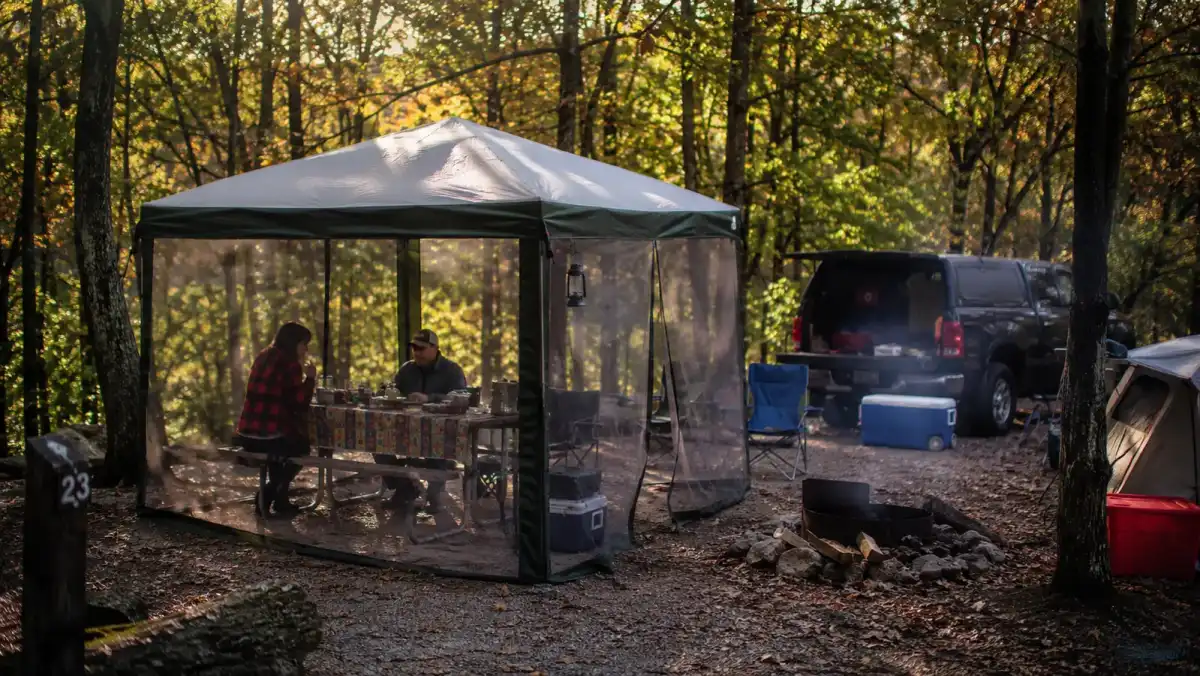
Every camper who buys one of these ends up finding me on Loop B within a week, wanting to know one of three things. Does it actually stop the bugs. Can it survive wind. Why does folding it back into the bag feel like fighting an octopus. I already answered all three of those at length in my full-season review, and I'm not going to repeat that ground here. What I want to cover instead is the stuff that doesn't show up until month three, the stuff a five-day test trip will never catch, and the stuff the Amazon listing photos are arranged specifically not to show you.
I bought the Alvantor Pop Up Screen House Tent the same spring I wrote that first review, and I kept it in rotation at my host site for two more full seasons after that review went up, well past the point where most reviewers have already moved on to whatever showed up in their inbox next. What follows here is what actually surprised me across those extra seasons, the spec on the listing I stopped caring about entirely, and the honest reasons I've watched other campers on my loop box this thing back up and send it back.
The Quick Verdict
Still a shelter I'd buy again, but the honest version of this review knocks off a few tenths for a capacity rating that oversells the real floor space and a frame that shows its age faster than the marketing photos let on.
Amazon Check Today's Price →Already read the full-season review? Here's what it left out.
The Alvantor Pop Up Screen House Tent is still worth owning, but knowing what shows up after month three changes how you'll use it. Check today's price on Amazon before your next trip.
Amazon Check Today's Price on Amazon →How I've Actually Used This One
My first review covered one full season, April through October, at my host site on Loop B. This one covers two more seasons past that, because I didn't retire the screen house when the first review published, I just kept setting it up outside my 22-foot travel trailer the way I always had. Same picnic table underneath it, same routine of staking all four corners before I put anything on the table, same nightly walk checking roughly forty occupied campsites where I'd see other campers' versions of this exact shelter going up and coming down.
What changes when you stretch the timeline is what you notice. A first-season review catches whether the mesh tears or the frame snaps in a storm. It does not catch the slow stuff, the stuff that only shows up after the fabric has been folded and unfolded fifty or sixty times, after three seasons of UV exposure, after enough repeat setups that you stop babying it and start using it the way a normal camper actually would. That slower timeline is where this review lives.
I also want to be honest about something I glossed over the first time. I'm not the only person testing this screen house. I've watched roughly a dozen versions of it, some this exact Alvantor model and some close knockoffs, go up and come down across my loop over the years. A good chunk of what's below comes from watching those other setups fail or hold up in ways mine hadn't yet, which is the whole reason a campground host's opinion is worth more than a five-star review left after one weekend.
The Month Three Discovery: Fabric Wear at the Pole Sleeves
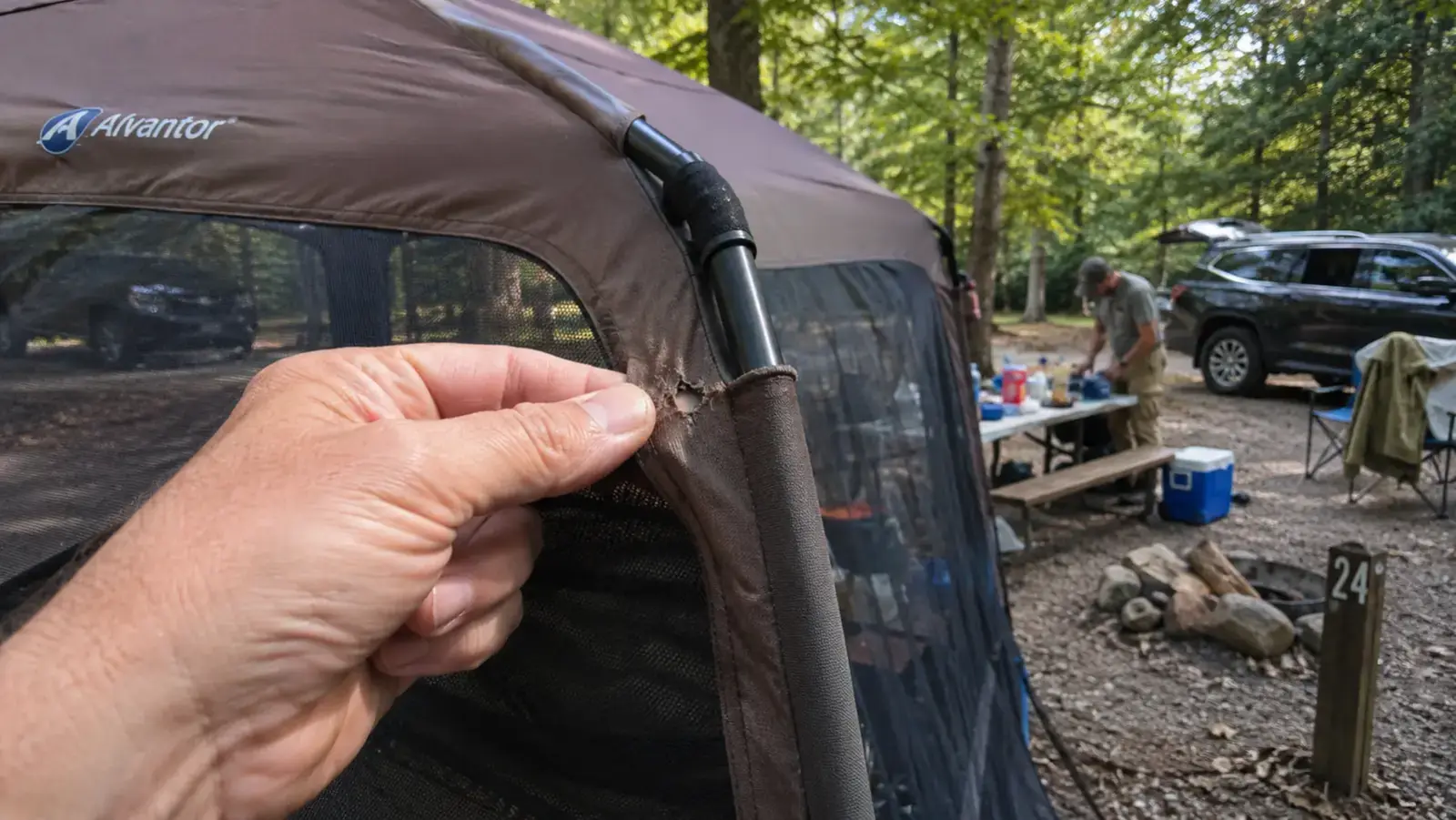
Here's the thing nobody tells you before you buy a pop up screen house, this Alvantor or any other brand. The frame poles aren't bare metal running through the fabric roof and walls. They slide through fabric sleeves sewn into the canopy material, and those sleeves are what take the friction every single time you pop the frame open or twist it down for storage. I didn't notice it in month one. I didn't notice it in month two. Sometime around month three of the second season, I ran my hand along a pole joint while folding it down and felt the fabric there had gone noticeably thinner than the fabric six inches away.
It's not a failure exactly, and it hasn't torn on mine even now, three seasons in. But it is real wear, concentrated right where the pole flexes hardest during setup and takedown, and it is the kind of thing that will eventually be the failure point on this style of shelter if you use it as hard as I have. I've since seen the same thinning on two other pop ups on my loop, both older than mine, and one of those had actually worn through to a small hole at a top pole joint by its fourth season.
The fix is simple and nobody puts it in the instructions. Fold it slowly. Don't force the twist motion, let the poles find their bend rather than muscling them. I started doing that in year two after I noticed the wear, and it's slowed down, though it hasn't stopped. If you want the full mechanics of that fold, I already walked through the figure-eight twist step by step in my full-season review. This is just the part that review couldn't have known yet, because I hadn't lived with it long enough.
The Capacity Rating That Doesn't Mean What You Think
The listing calls this a 2-10 person shelter, and technically I understand why. You could physically stand ten people under this roof, shoulder to shoulder, for a photo. But nobody camping is standing ten people shoulder to shoulder under a screen house. They're putting a picnic table under it, some chairs, maybe a cooler, and trying to move around that setup without knocking a lantern off the table edge.
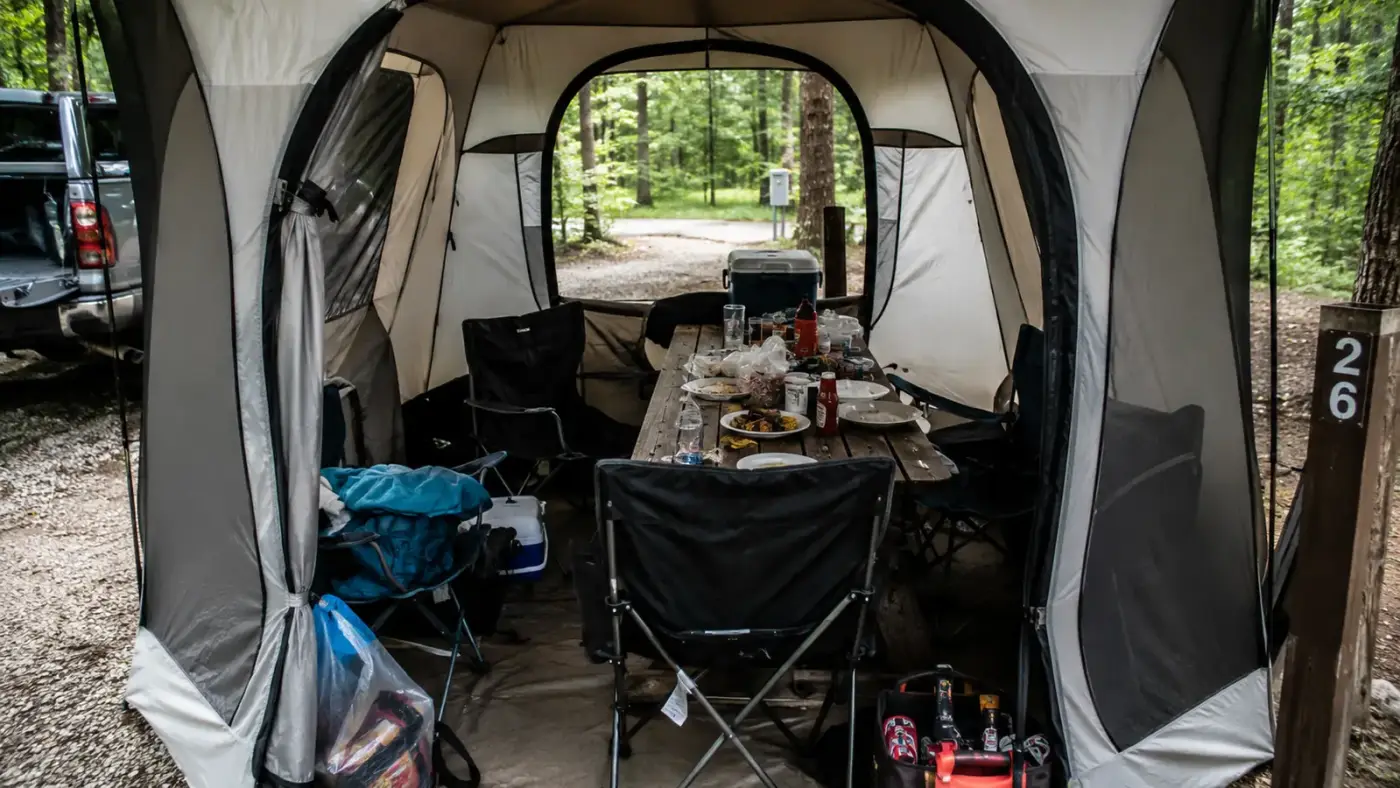
Once you put a full-size campground picnic table inside, which is what this shelter is actually for, the real comfortable capacity drops to four or five people sitting, with room to walk around the outside of the table but not much more. I've set up folding chairs for six around my table under this canopy exactly once, for a cookout with neighbors on my loop, and it worked, but it was tight enough that two people had their chair backs brushing the mesh wall all evening. That's not a defect. It's just a rating that's measuring an empty room, not a used one, and the listing photos never show a table and chairs actually in there, only an open, empty interior that makes the space look bigger than it lives.
If your plan is dinner for two or three people with a table and a cooler, the capacity is a non-issue and you can stop worrying about the number entirely. If you're picturing a full extended family gathering under one screen house, size up your expectations before you buy, or look at how this stacks up against a simpler shade option in my comparison against a dining fly tarp, which trades the bug protection for a wider open footprint.
What the Listing Photos Don't Show You
I've looked at the Amazon listing photos for this screen house more times than I can count, mostly because campers on my loop pull them up on their phone to show me before they buy. A few things are consistently missing from every one of those photos. The first is the ground footprint. Every listing shot is taken on a flat lawn or a clean patio. At an actual campsite, the four stakes and the frame's weight leave a rectangle of flattened, slightly discolored grass or gravel underneath within a week, and if you move the screen house to a new spot mid-trip, that mark is right there for the rest of the stay.
The second thing is the included stakes. They're serviceable, but they're thin steel, closer to what comes with a cheap dollar-store tent than the stakes you'd buy separately for a real tent. I bent one of mine on a rocky site in the first month and just replaced the set with heavier stakes from my own gear box, which I'd recommend doing before your first trip rather than after you bend one.
The third is the mesh color under real light. In the listing photos the mesh reads as a light, almost translucent gray. In direct afternoon sun at a campsite, it darkens the interior more than I expected the first time, which is honestly a plus for keeping the inside cooler, but if you're picturing a bright, airy space for reading or working, it's dimmer under there than the photos suggest, especially by midafternoon.
Who Actually Sends This Back, and Why
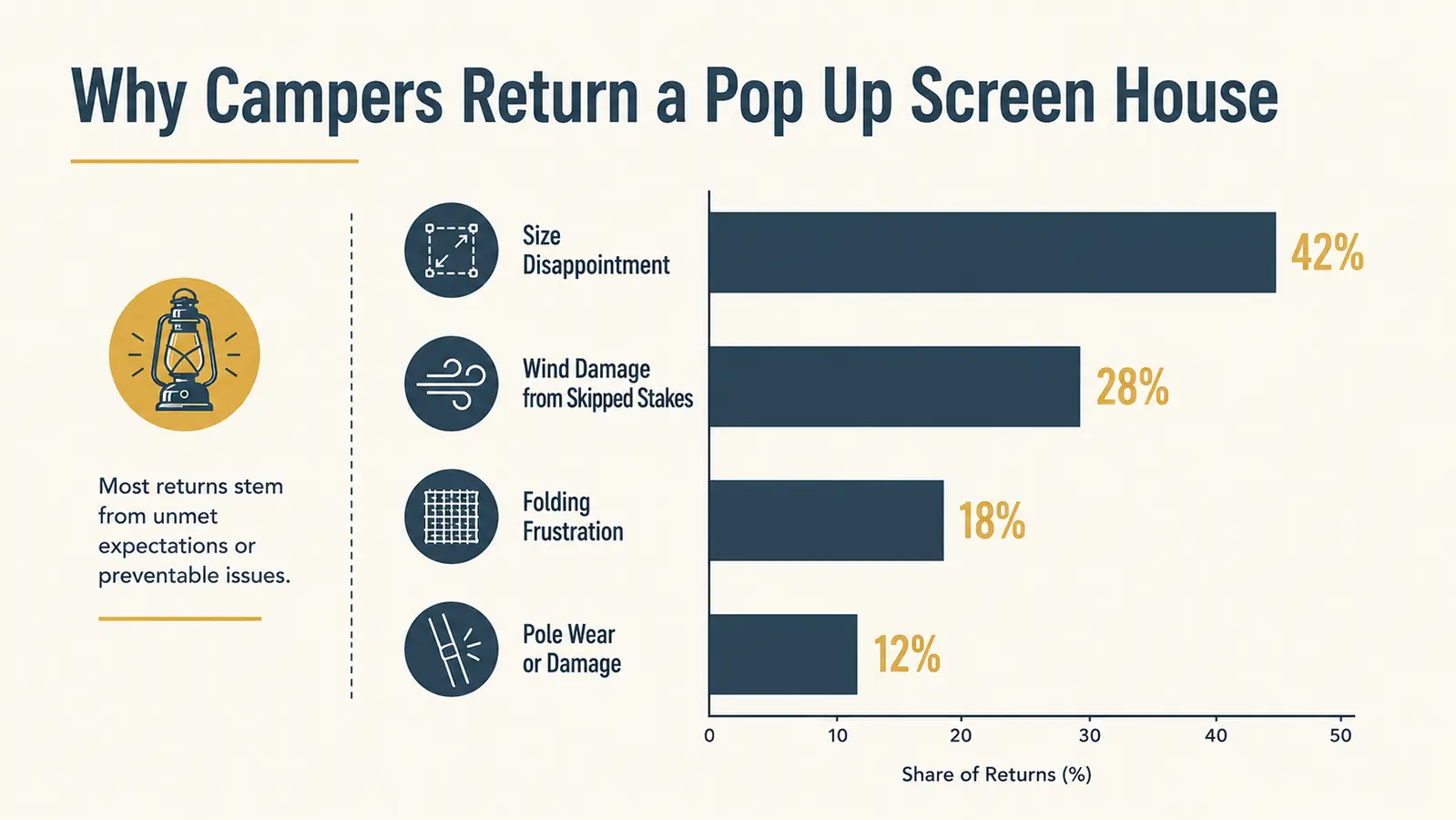
I've talked to enough campers on my loop who bought and then returned a pop up screen house, this one and others like it, to see a pattern in why. It's almost never that the shelter is defective out of the box. It's almost always a mismatch between what the buyer expected and what a screen house actually does.
The single biggest return reason I hear is size disappointment, exactly the capacity issue above. Someone pictures a full family reunion under the roof, sets it up, and realizes it comfortably fits half of who they imagined. The second most common reason is wind damage, and to be blunt, that one is almost always a setup mistake, not a product flaw. I've watched campers unbox it, pop the frame, and never touch the included stakes because the site looked calm that evening. When a gust comes through later that night, the frame goes over, something bends, and the return goes in as "broke in one use" when the honest cause was skipped stakes.
The third reason is the fold. I covered the figure-eight twist motion in detail in my other review, but I'll say it again here because it drives real returns, not just frustration. Campers who never practice the fold at home end up fighting it at the campsite on checkout morning, sometimes for twenty minutes, and a few of them have told me straight out they returned the whole shelter out of pure frustration rather than learn the motion. That's an avoidable return if you take five minutes in your own yard before your first trip.
Replacement Parts and What Alvantor's Warranty Actually Covers
This is the section nobody writes because it only matters once you already own the thing and something on it wears out, which is most of what this review is about. Alvantor sells individual replacement fiberglass poles and a handful of hardware pieces separately, and I only found that out because a pole tip on a neighboring camper's identical shelter cracked in its second season and he asked me how to fix it rather than buy a whole new screen house. Ordering the single pole was cheaper and faster than he expected, and it saved him from replacing a shelter that was otherwise fine.
The listing itself doesn't advertise this, and most buyers assume a broken pole means the whole unit is done. It isn't. If you keep the original packaging with the model information on it, or just photograph the frame before you ever set it up the first time, you'll have what you need to order the right replacement part later. I wish I'd known that in year one instead of stumbling into it because of someone else's cracked pole in year two.
None of this shows up in a first-season review because nothing breaks in a first season if you're staking it correctly. It only becomes useful information once you're the kind of owner I am now, someone who's kept the same shelter going long enough to need a spare part instead of a whole new purchase.
What I Liked
- Held up well across three full seasons of real use, not just one, with the frame still functional and no tears in the mesh
- Genuinely effective bug barrier once staked properly, which the honest capacity issue does not change
- Fabric pole-sleeve wear is slow and manageable if you fold it gently rather than forcing the twist
- Real usable capacity for a table and four to five chairs, which covers most car camping groups even if the listed number oversells it
Where It Falls Short
- The 2-10 person rating is misleading once you actually put a picnic table and chairs inside
- Included ground stakes are thin and bend easily on rocky sites, worth upgrading before your first trip
- Fabric at the pole sleeve joints shows measurable wear by the third season of regular folding
- Listing photos don't show the ground footprint mark it leaves, or how dim the interior gets under real afternoon sun
The screen house doesn't fail the way people expect it to. It fails the way a rated capacity fails when you finally put a real picnic table under it, which the listing photo never does.
Who This Is For
This is a solid buy for a car camping group of two to five people who want a real bug barrier over a picnic table and are willing to size their expectations to that number rather than the listed ten. It's also the right buy for anyone planning to keep a screen house in rotation for multiple seasons, not just one trip, since the wear I've described here shows up slowly and is manageable if you handle the fold with some patience. If you've already read my full-season review and staked it correctly every time, this honest follow-up should mostly confirm what you already suspected rather than change your mind.
Who Should Skip It
Skip it if you're picturing a shelter that fits a large family gathering comfortably, that's a different product entirely, something closer to a full-size event canopy rather than a pop up screen house. Skip it too if you're not willing to spend five minutes practicing the fold at home, because that single skipped step is behind a real share of the returns I've watched happen on my own loop. And if what you actually need is bright, open shade rather than bug protection, my comparison against a dining fly tarp will steer you toward the simpler option.
Now you know what the first season doesn't show you.
Three seasons in, the Alvantor Pop Up Screen House Tent is still the shelter on my picnic table, oversold capacity and all. Check today's price on Amazon and size your expectations before you buy.
Amazon Check Today's Price on Amazon →